Skip to content

Posts tagged ‘dogs’

Be Responsible, Respectful, Safe: Ask First!

Can I get a drum roll up in here?

I’m so happy to present the brand new DINOS Public Service Announcement: Ask First!

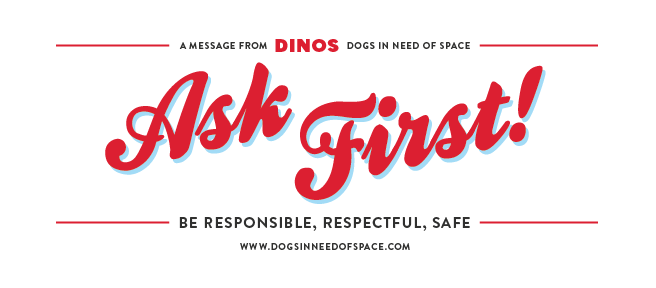
Check out this retro-tastic poster from my favorite design geniuses over at Design Lab Creative Studios:

DINOS: Ask First Poster

Want one?

You can get the poster for free on Flickr. Just right click, hit “save as” to download, and print!

There are also translations (Italian, German, Spanish, Japanese) of the poster available on Flickr.

Or you can purchase quality prints of the poster, in various sizes, on Cafe Press.

As a companion piece, you can download and print this brand new Ask First handout

And just in case you want more…there are Ask First tees and stickers.


Ok, that’s the business end of things, but let’s get to the heart of the matter:

Why Ask First?

Because whenever you see a dog, you should always ask permission before you approach them.

Never assume it’s OK for you or your dog or your kid to approach a dog without asking first. I mean, you know what they say about assuming right? It’s the truth.

When you see a dog walking on leash, sitting in the waiting room at the vet’s office, walking next to his owner in a pet store, working as a service dog, or just about any where, you should ask before you let your dog greet them or you make a move to pet that dog.

Just ask first.

Ask First DINOS

It only takes a very brief moment and with just one question, “Can I/my dog/my kid say hello to your dog?” you’ll be respectful of others, responsible for your actions, and you’ll be safety first.

The nice thing about asking is that it’s something all of us can do at any time. All you need is your voice. It’s that simple.

This may seem silly  – it is common sense after all – but I think that we’re all overdue for a reminder. Most of us are teaching children to ask before they approach dogs, but the adults need a refresher course too. And we all need to recognize that this applies to dog-dog greetings as well.

Let’s help people form a new habit. If they’re reminded enough, perhaps more folks will remember to ask permission before they let their dogs or themselves run over to say “hi” to a dog. They’ll stop making assumptions and start making responsible choices.

I know it’s a long shot and it won’t reach the truly reckless dog owners out there,  but a friendly reminder can’t hurt right?

By the way, dogs don’t have to be a DINOS for this to idea to apply. Even dogs that are really social and able to meet others at any time deserve to be treated with respect. And all dog owners have a right to say “no thank you” for whatever reasons they choose.

It’s our right as dog owners to decide what’s best for our individual dogs and ourselves. Asking first allows all of us to make that choice.

In fact, this applies any time any of us are out in public with our dogs. Before you let your dog jump up to greet a child: Ask First. Before you let your dog pull his retractable leash over to a senior citizen: Ask First. Before you allow your dog to approach anyone unfamiliar (you never know who is afraid of dogs!): Ask First.

So why not Ask First and be responsible, respectful and safe around all dogs, all the time?

If you think the public could use a little refresher on this idea, please print out a poster and hang it in a vet’s office, a pet store, a school, an on-leash area, or any place where folks need a reminder to Ask First!

And if you do, snap a photo and share it with Team DINOS on Facebook!


p.s. Some people have asked why there aren’t any yellow ribbons in this poster. I chose to leave them out because the public needs to learn to control their dogs, obey leash laws, and ask first around ALL dogs, not just ones that might be wearing a ribbon!

Junk in the Front: Dog Coats that Fit

It’s FREEZING in Maine this week. The only people walking around these days are the dog walkers and the postal carriers. Half the dogs I walk are disgusted by this weather and demand to be taken inside right away, the other half are oblivious to the cold, no matter how many times I tell them that I can’t feel my legs anymore.

Since it’s 5 degrees out, I figured this might be a good time to talk dog coats. If you have dogs that are shaped like triangles, like I do, it can be hard to find coats that fit them. Both of my dogs are very broad in the chest but have narrow waists and I had to try a million coats before I found ones that were big enough up front, without being super long and huge all over.

In Birdie’s case, she’s got so much junk in the front that she has a tendency to bust her coats open at the chest. So she starts off fine, but then she takes one breath and the front strap explodes open. Next thing you know, she’s running around with her coat “unzipped”, trailing from around her waist, like some sort of streaker. It’s embarrassing.

So, if you have a top-heavy public exhibitionist of your own, there are a few brands that I’ve found worked well for my dogs. Of course, they might not fit your pups. That’s the thing about dog coats: usually your dogs have to try a few until they find the right one. And there’s no universal sizing system. If you’re in the market for a coat, I recommend visiting a pet store that offers a range of brands to try on. If your dog can’t handle doing a fashion show in a pet store, buy a bunch to take home and then return the ones that didn’t fit (let the store know what you’re up to and find out if they have a good return policy first!). Same goes with ordering online: buy a couple of sizes/styles and return what doesn’t work.

Here are the coats that I like for my dogs (for reference, Boogie is 50 pounds with a very narrow waist and Birdie is 40 pounds and shaped like a hot potato.)


Chilly Dog Sweaters: I know a lot of dogs with big chests that really rock these affordable sweaters. In fact, they’re a wardrobe staple among those of us with bull dogs (any kind of bull). They almost always run long, covering their tushies a bit, but the sweaters stretch and fit their chests really nicely. Plus they have adorable designs, like this monkey. The sweaters run small: so usually you need to go up a size larger than normal for the right fit. I think Boogie is an XL or XXL.

notes from a dog walker: boogie


Teckelklub Trench Coats: This was the first coat I found that could contain Birdie’s bust line with ease. No Velcro busting to be found with this baby. Both of my dogs have the fleece-lined Trench style coats. On really cold days, Boogie will wear his Chilly Dog sweater underneath and this coat on top. But most of the time, the coat alone does the trick for him when he’s out making sweet love to his big red ball in the snow. Boogie is a size 6, Birdie is a size 5 in this coat.

notes from a dog walker: cuz and coat


Apache River Dog Coats: The next time I have to buy a coat for a dog, this is what I’m going to get. I used to work in a pet store that sold Apache River and on the coldest days these simple coats would fly off the shelves. Made by folks who also make horse blankets, these fully lined fleece coats are very warm and they fit dogs so well. I highly recommend them for any shaped dog. Like sweaters, they slip over the head, so there’s no Velcro strap across their chest to bust open. And the extra coverage up front is good for cold climates where every exposed inch counts.  There’s a ton of stretch in these snug coats (think Spanx for dogs), so what fits in the front, will also fit in the waist. Plus, they make x-long versions for wiener dogs. What up!  

animalstars.com: apache river coats
There are tons of other options out there: Ruff Wear, LL Bean, RC Pets…but if you’re looking for coats that fit dogs with junk up front, those are my top 3 picks. Oh, and here’s one more, just for fun:

notes from a dog walker: coat

We won this cheap-ish dog coat in a raffle years ago. It fits Birdie perfectly and she’s taking a nap in it right now. She told me the faux sheepskin shearling coat makes her feel rugged – like a rancher or a cowboy.  Hey, as long as Birdie isn’t flashing anyone, it works for me.

Do you have an odd ball dog that doesn’t fit into regular stuff? Tell me about your favorite coats and sweaters in the comments section!

2014 update: My friends at Fit For a Pit carry an amazing collection of dog coats and clothes that fit pit bulls and other chesty dogs. I love their products so much that, yes, this is an affiliate link.


Money Talks: Do You Support Companies That Discriminate?

I just broke up with my auto insurance carrier.

For years (long before I had dogs), I’ve been a happy Progressive customer – good rates, good customer service, no complaints. Until this year when I bought a house. Because we have a dog that is a pit bull , we planned in advance to get our home owners insurance through State Farm because they have a great reputation within the pit bull community.

When I contacted State Farm for a quote, I told them what kind of dogs we have. They didn’t care. All they wanted to know was if they had a bite history. Our dogs don’t, so we had no problems.

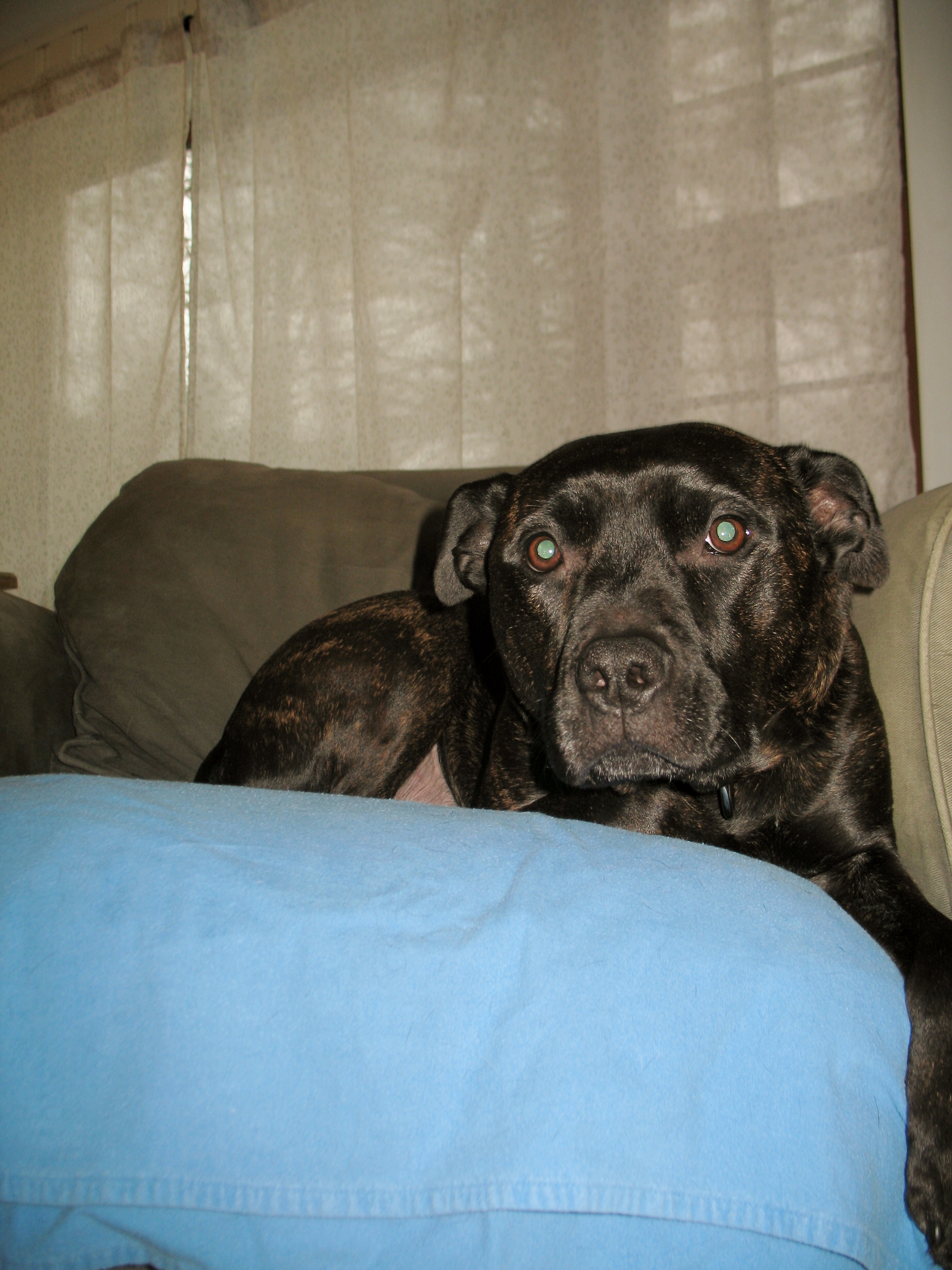
Boogie has a history of moping. State Farm didn't mind.

Boogie has a history of moping. State Farm didn’t mind.

Then, when it came time to renew my auto insurance, it got me thinking: I’d like to bundle my home and auto insurance. Does Progressive offer home owners insurance and, if so, would they insure my dogs, regardless of their breed?  I asked Progressive for a home insurance quote and found out that they do insure pit bulls, but only if I’m willing to pay a hefty “dangerous dog breed” fee.  Uh, no thanks.

Now, I appreciate that Progressive at least offers the possibility of home insurance for families with pit bulls (and other “dangerous dogs” like, Dobermans, Rotties, Chows, etc.), because there are many companies that flat-out do not. Many families are forced to give up their pets because they cannot find insurance that covers certain breeds or mixed breed dogs. So, in areas where there are no other options, at least Progressive offers families (the ones who are able to pay a few hundred extra bucks) an option.

But still. It’s a discriminatory fee. It punishes many dog-owning families, particularly lower-income ones who cannot afford to pay hundreds of dollars extra each year, just because of how their dog looks. No fair.

Luckily, I do have options that don’t penalize me for choosing to love a little Boogie. And so, despite the fact that State Farm’s auto insurance cost a little bit more than Progressive’s policy, I dumped Progressive and bundled up over at State Farm. I could have kept Progressive as my auto insurance and State Farm as my home owners insurance.  I could have kept seeing both companies, juggling my affairs with two different agents, but I’m just not that kind of gal. I want a committed relationship where my agent accepts me for who I really am: a dog lover. An all-dogs lover.

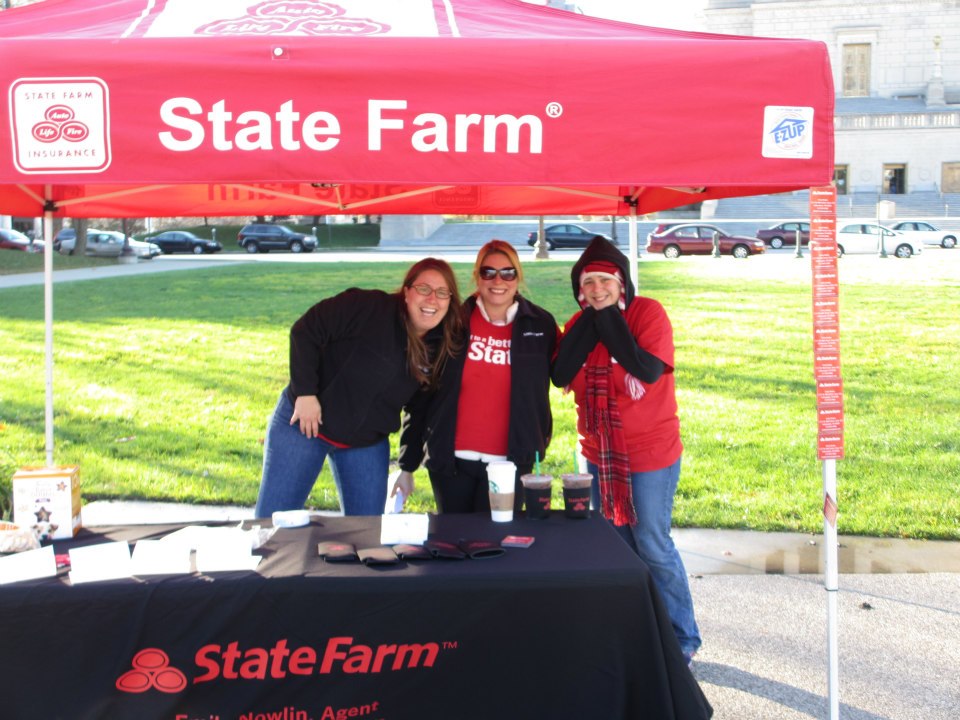
State Farm at an Indy Pit Crew Event

State Farm at an Indy Pit Crew Event: http://www.indypitcrew.org

I’d rather give ALL my money to a company that chooses not to discriminate. Money talks.

Of course, Progressive wanted to know why I left, so here’s what I wrote them:

“I left Progressive for only one reason: while shopping for home owners insurance, I discovered that your company considers my dog to be a “dangerous breed” and would charge me an additional fee in order to cover him. My dog is not dangerous and doesn’t have a bite history. Therefore, I took all of my business to State Farm, which does not discriminate against dogs based on how they look or their breed. Instead, they are only concerned with actual behavior and treat every dog as an individual. I was very happy with Progressive and would have loved to continue giving you my business – both auto and home – but I cannot patronize businesses with discriminatory practices, fees, or penalties. If you ever change policies and evaluate dogs based on their behavior, not their looks, I’d be happy to return.”

I haven’t heard back, but I’m not waiting by the phone at night. Breakups, right?

What about you? Does your insurance company discriminate? There are so many dogs affected by insurance discrimination: Chows, GSDs, Rotties, Dobermans, Akitas, Mastiffs, Great Danes, Boxers, Huskies, and many more. Are you giving your hard-earned bucks to an insurance company that discriminates against dogs based on what they look like? As a dog lover, how do you feel about supporting a company that would deny a certified therapy dog coverage because they’re a Rottweiler or an Akita? Or one that makes assumptions about my dog’s behavior just because of how he looks?

As dog lovers, we have to stick together. It’s the only way we can influence profit-driven businesses to stop discriminating against dogs based solely on how they look. To be honest, we also have to stick together to fight Breed Discriminatory Legislation in our local governments (how can we expect businesses not to discriminate, when certain governments are doing so?), but letting your wallets talk in the private sector is a step we can all take too. There really is no excuse for businesses not to treat all dogs fairly. State Farm is doing well financially, so insuring all these families with “dangerous dogs” isn’t ruining them. Why can’t other companies follow in their fair, profitable footsteps?

Please know that insurance is no small thing for many dog lovers. Housing is a major issue for lots of families. There are people who can’t find home owner’s insurance and have to give up their beloved family dogs. There are landlords that want to rent to all dogs, but their insurance companies don’t allow them to be fair. There are SO MANY renters that can’t find housing because of this issue and many wind up giving up their dogs.Those dogs don’t always survive being surrendered to a shelter. And, even if they did, is that really the best use of our animal shelters? As a refugee camp for dogs who are loved, wanted, and well cared for, but weren’t insurable just because of how they look?  Uh, a million times no.

So, I’m asking you, my fellow dog lovers: if your auto policy or any other insurance policy is up for renewal soon, would you consider taking your business to an insurance company that does not discriminate? Will you put your money where your heart is and stand with me and Boogie? I know it’s a pain in the tush to switch. It took me way longer than I care to admit to stop being lazy and do the right thing for my own family. But maybe, like me, you’ll one day feel compelled to deal with the temporary inconvenience of switching so that you can align your spending with your ethics.

And if you’re looking, you do have options. Here are some companies (it may vary from state to state) that are helping families stay together: State Farm, Farmers (see update below), USAA, and Travelers are a few.  There’s even this company with a pit bull on their website and a list from Bad Rap with options nationwide.

Why not get a quote from one of these and then reward them for treating all dogs and families fairly by giving them your business?

You’d be Boogie’s hero.


Update 2/12/13: Farmers has changed their policy regarding pit bulls, Rottweilers, and wolf-hybrid dogs. More on that here.  As of this date, the change is only in CA, however all families with Farmers insurance would be smart to look for an alternative to Farmers home owners insurance now. Additionally  I reached out to State Farm and today they confirmed that they are not following Farmers lead and will continue not to discriminate against dogs based on breed. 

Boarding Kennels for DINOS

Below you’ll find a list of boarding options recommended by the Team DINOS fans on Facebook. Happy Boogie

These boarding kennels have been a good fit for their DINOS, particularly those that are not social with other dogs. Every dog is an individual and there are many types of DINOS, so please keep in mind that what works for one DINOS family, may not work for another.

This list is a great place to start your search and there are a wide range of options below. Some offer small, private home-like boarding, while others are giant resorts with luxury packages. Contact these facilities and ask for a tour. Get to know the staff and find out how they handle dogs of varying temperaments and social skills. Determine if their training and handling skills are a good fit for your dog and in line with your own training/handling philosophies. Here are some questions to ask. Make an informed choice!

The list is always expanding, so be sure to check back and if you’d like to recommend a boarding option, leave a comment or email me: info@notesfromadogwalker.com

Please note that being included in this list is not an endorsement by the author of this blog.


UNITED STATES

AZ Cave Creek: Partners Dog Training

CA Dublin: Dublin Creek Kennels

CA Oakland: Citizen Canine

CA Oceanside: Bark Ave Resort and Kamp

CA San Jose: Canine Corral Dog Daycare and Overnight Care

CA San Francisco: Mighty Dog Walking & Boarding Services

CA San Francisco: Pet Camp

FL Hawthorne: Sun Kiva Kennels

FL Lake Mary: Hollywood Houndz Boutique & Spa

FL Riverview: Canine Cabana Florida

GA Athens: Pawtropolis and Helping Paws Rescue

GA Atlanta: Happy Healthy Pup  

GA Atlanta: K-9 Coach

GA Cumming: Just Pets Veterinary Hospital  

IL Chicago: Paradise for Paws

IL Chicago: Stay. A Modern Dog Hotel

IL Frankfort: K9 Tail Shakers

MA Boston: Fenway Bark

ME Greene: The Dog Rehabilitation Center of Maine

ME Portland: Forest Ave Veterinary Hospital

ME Saco: Suntar Kennels

MD Owings:  Countryside Kennels  

MI Romulus: Curreys Family Pet Care Center

MN Eden Prairie: Wag ‘n Woofs

MN Lanesboro: A Dog Spot

MN Minnetonka: Auntie Ruth’s

MN Plymouth: Plymouth Heights Pet Hospital

MN St. Paul: Dog Days

MO Hillsboro: Green Roof Kennel

NC Raleigh: Suite Paws Pet Resort & Spa

NH Manchester: Gail Fisher’s All Dogs Gym

NJ Millstone: The Green Leaf Pet Resort

NV Reno:  Canine BNB

NV Reno:  Honey Bear’s Country Kennels

NY Fishkill: Pet Pleasers

OH Burton: The UltiMutt Inn & Pet Resort

OH Seville: Comfort Kennels

OR Tigard: GoInBark 

PA Freedom: Lucky Paws Pet Resort

PA Pittsburgh: Paws Here Awhile  

PA Reading: Peacock Bridge Kennels

RI Providence: Outbound Hounds

SC West Columbia: Barnwell Oaks Kennels

TX Flower Mound: Canine Courtyard

TX Seabrook: The Majestic Pet Hotel & Boutique 

TX Round Rock: Action Pack Dog Center

TX San Antonio: Becker Animal Hospital

UT Draper: K9 Lifeline

UT Salt Lake City: Doggie Mannerz

UT Zion National Park: Doggy Dude Ranch

WA Monroe: Mystic Mountain Retreat  

WA Sequim: Dungeness Pet Resort

WI DeForest: Aunt B’s Pet Resort and Spa


CANADA

Lethbridge AB: Bogdan’s Boarding Kennel and Dog Training Centre

Edmonton, AB: Kennels Bed and Biscuit

Calgary AB: Whiskers & Wags Pet Services

Abbottsford BC: LAPS Special Boarding Program

Vancouver BC: Bronte Pet Services

Bloomfield ON: Winstead Dogs

It’s Not How They’re Raised, It’s How Dogs are Managed That Matters Most

How many times have you heard someone say about a dog, “It’s all how they’re raised”?  Probably a lot. If you own a pit bull dog, probably a lot more.

I hear pit bull advocates saying it all the time, as a way to defend our dogs. I hear other saying it as a flippant remark about dogs in general.  This phrase gets tossed around all the time, but no one seems to be aware of what they’re really saying….and how damaging it can be.

This saying does have a kernel of truth  in it, of course, but “how they’re raised” is just one of the factors that contributes to who our dogs are. It’s not the whole story. 

When people believe that “It’s All How They’re Raised”, there are some real-life consequences for the dogs. So we need to check ourselves. 

Here are a few ways our words hurt:

People refuse to adopt adult dogs. This idea, that how they’re raised determines who a dog is, makes adopting out adult and senior dogs a real challenge. Why would adopters take a chance on an adult dog, who has been raised by someone else, when they could adopt a puppy and raise it “right” themselves? Some folks really believe this. Seriously, shelter workers are constantly confronted by this way of thinking. It stinks.

Shelters won’t place victims of cruelty up for adoption. If a dog has survived an abusive or neglectful situation, such as dog fighting, animal hoarding, puppy mills, etc., then it is known they were “raised wrong”. Some organizations use this as proof that the dogs aren’t safe or fit to be adopted out.The same thing goes for dogs that are suspected of surviving these situations. If the assumption is made that a dog with cropped ears has been fought, that assumption of their past may wind up costing the dog his life if policies dictate that fight bust dogs are not adoptable because they were obviously “raised wrong.”

Responsible dog owners feel like failures. People who have raised their dogs since puppyhood beat themselves up when they’ve done everything right, but despite their very best efforts, their dogs still have behavioral issues. I hear from a lot of you through DINOS because you feel ashamed and guilty about your dog’s issues, despite having raised your dogs right. Let me just say it now: it’s not all how a dog is raised that matters. You guys have to stop beating yourselves up (even if you’re a dog trainer).

Here’s the reality – dogs are who they are due to many factors: training, breeding, socialization, management, genetics, and environment. All of these things influence who our dogs are.

A dog’s past is a chapter, but it’s never the whole story. Let me show you:

“Raised Wrong”

Some dogs, neglected and abused their entire lives, are well-adjusted, social dogs. Anyone who has worked in rescue has met countless dogs who were not raised in the best circumstances, but despite this lack of early socialization or care (or worse) they turn out to be safe, family dogs. Many of us share our homes with dogs that were raised in less than ideal conditions, but are still wonderful pets.

One example of this scenario are the dogs rescued from fight busts or hoarding situations. Despite terrible beginnings, many of these victims of cruelty are ready to leave the past behind and enjoy family life. They may need training and structure to get used to living with a family in a house (what dog doesn’t?), but some of them are able to adjust to family life with relative ease. Their past didn’t help them do this, you dig?

Meet Jagger, the handsomest dog on earth! Visit his Facebook page to meet this sweet boy.

Meet Jagger, the handsomest dog on earth! Visit his Facebook page to meet this sweet boy.

“Raised Right”

Some dogs, purchased from responsible breeders and socialized properly from puppyhood, still wind up with behavioral problems. Many responsible dog owners, who have raised their dogs since they were puppies and did everything right, still find themselves with dogs who have a variety of behavioral issues. These dogs were “raised right”, but are still struggling, sometimes due to genetics.

One example of this is illustrated in an article written by a dog trainer who shared her problems with her own dog. Despite her very best professional efforts to train and socialize him, aka raise him right, he has significant behavior issues which may be caused by a medical condition. It’s not how he was raised that’s causing the problem. Read it here.

Puppies. It's not just how you raise them.

Puppies. It’s not just how you raise them.

In both of these cases, the common denominator that is actually determining the success of these dogs as family pets and their safety in the community isn’t how the dogs were raised: it’s responsible management.

Whether they were raised “right” or raised “wrong” in the past, no matter what behavioral problems a dog does or doesn’t have, when owners recognize their dog’s individual needs and provide them the right care and management tools, dogs have a chance to succeed in our crazy world.

More Present, Less Past

So, it’s not “how they’re raised” (what happened in the past) but rather, “how they’re managed” (what’s happening in the present) that needs to be our focus, if our goal is to help our dogs and  also create safe communities for us all to enjoy.

We can look to their past for clues and guidance, of course. I don’t mean ignore it all together. But we do more for our dogs when we look at them right now, without the haze of a bad (or good) past fogging up our thoughts.  Who are they right now? What do they need to succeed today?

Whoever they are, dogs always exists and act in the context of human beings. They don’t live in a vacuum. They live with us. We need to recognize dogs as individuals, then determine what they need from us in order to succeed in the world.

What this means is that when dogs are properly managed by a human, a dog with or without behavior problems has the opportunity to be a safe, family dog. Dogs may need a variety of management tools, depending on what behavioral issues (if any) they have.  Beyond training, various management tools might include: space management (crates, gates, etc.), muzzles, leashes, fences, proper supervision, etc. I’d also include medication in this category, if it’s necessary. When these tools are used, owners are setting dogs up to be successful.

This also means that any dog that is not managed properly can be a nuisance to the community or a danger to others. We see this often in the case of dogs that are running loose in neighborhoods. The dogs may be friendly (or not), but by allowing them to roam the streets or chase other dogs, their owners are setting these dogs up to get into trouble. They are not managing them. They are setting them up to fail.

side note:  This is why I’m such a stickler for obeying leash laws. It’s a management tool.  I just wish the laws were enforced.
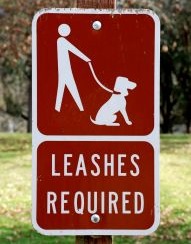
leash sign


I think that dogs are only as successful and safe as humans set them up to be – no matter what their past may be. When a dog gets in trouble or acts dangerously, somewhere along the line, a person has failed to make the right choice. But that’s not the same as “how they were raised”.

How they’re raised may be one factor that influences dogs, but it doesn’t determine the whole being of a dog. Perpetuating this idea only winds up hurting dogs with less than perfect pasts and shaming people who own dogs they’ve had since puppyhood.

The truth is that it’s how we currently manage dogs that determines how any dog interacts with the world. When we focus on managing them in the present, based on their individual needs, we can set dogs up for success despite what may have happened to them in the past.

So can we trash “its all how they’re raised” once and for all? It’s such a drag for dogs and their owners.

Let’s replace it with the truth:

It’s all how they’re managed. Dogs are only as successful as we set them up to be.

PDF version here: It’s Not How They’re Raised
No More (Doorbell) Drama

If your dog goes bonkers every time the doorbell rings, may I suggest this?

Over the weekend I picked up a wireless, plug-in doorbell for $15 at Home Depot. I bought it because our new house has a funky entrance that forces visitors to enter our small, enclosed porch in order to get to our front door. Rather than having strangers half way into the house before they could ring a bell (and startle the pants off of me), we got a wireless doorbell and installed it on the outside of the house. This allows people to stand on our front steps and ring the bell – without entering the porch/house – and gives me a second to tell Boogie to go to his room and chill out while I deal with botherers vistors.

Turns out, this little gadget has a bonus function: my dogs don’t recognize the chime as the doorbell! So when someone rings the new bell, Frick and Frack don’t bark. My mom also has one of these bells and she reports that her dog doesn’t bark at the wireless door chime either – so it’s not a fluke. Two out of two families recommend it.

Granted, desensitizing dogs to the sound of the regular doorbell and teaching them to stay calm is the way to go about this issue. And you can use these battery operated, portable doorbells to do that sort of training. But hey – it’s not such a bad thing that the new bell doesn’t register, in their ears, as a doorbell.  Of course, that will change with time as the dogs make the connection that the ‘new sound’ = people at the door. In the meantime,we’re working with a clean slate.

So, if your dog turns into a hot mess at the sound of the doorbell, this cheap solution just might be what you need to help them make some progress. The kit I bought only had 2 different tones to choose from, but other more expensive kits, give you the option of 8+ chimes to pick from. So in theory, you could keep changing the sound and your dogs will be totally mystified for years.

And for anyone that has a weird front door set up, like me, this is a great, cheap solution because YOU get to decide where visitors stand when they ring the bell. Buy yourself some extra time and put your doorbell somewhere really convenient – like next to a pay phone at the end of your driveway, so visitors can call first and tell you they’re about to ring the door bell. That should give you enough time to tell your dog to “go to his mat”, right?

And if you get one now, it’ll be just in time for all those cute intruders Trick or Treaters!

So go for it – put an end to all that doorbell drama! Mary J. Blige understands, don’t you Mary?

Book Review: Things Your Dog Doesn’t Want You to Know

Generally speaking dog humor books never make me laugh. There’s usually a lot of jokes about dogs eating trash and looking guilty and contrary to what the titles may imply, they actually slay my soul. I try to avoid them.

So, when I got asked to review a copy of the book Things Your Dog Doesn’t Want You to Know, I wanted to say no, but wound up saying yes for two reasons: there is a quote from Steve Martin on the front and I read an excerpt entitled, “I Can Poop The Second I Start My Walk.”

Steve Martin is one the funniest people of all time. Even if he never actually read this book, just the idea that he may have looked at the cover or tripped over the book, is enough for me. And once I read that “I Can Poop” line, I knew the writers must know something about dogs.


Things Your Dog Doesn’t Want You to Know is a collection of stories from eleven fictional dogs who reveal what’s really going on in the minds of dogs. Among others, there’s Orson the Bulldog who has an eating disorder, Tinkerbell the passive aggressive Chihuahua, and my two favorites: Sarge the working GSD who gets fired a lot and Rufus T. the Bloodhound that dreams of making it on Broadway.  It’s a fun crew.

What I enjoyed about this book is that it was really obvious that the writers not only love dogs, but understand dogs and what they’re up against having to live with humans. Without going straight for the teachable moment, the authors wove all kinds of helpful tips, advice, and dog logic into their stories.

The dogs, in telling some really funny stories, subtly teach readers that dogs see the world differently than we do and that they’re  totally justified when they do something “bad”, because it makes total sense. You just have to look at it from the dog’s perspective.

If a couch is made of leather, why would a dog think it’s any different from a rawhide chew toy? Axelrod the Lab tries to explain why so many dogs make this mistake in “Why I Ate the Sofa” and other stories about misunderstandings.


If you have a new dog owner in your life – one that’s trying to figure out how to speak dog – this would be a good gift to give them (along with some Nature’s Miracle). They’ll get the answers to all our burning questions: why do dogs eat grass? jump on us? dig holes? steal our weed?

The book also serves as a reminder to humans that we should never judge a dog by his looks, as in the case of Rufus T. the Bloodhound, a dog with a secret fantasy of making it on Broadway. His people assume he wants nothing more than to go hunting, but  Rufus reveals that when he’s dreaming, those jerky movements and whimpers aren’t from squirrel chasing, he’s dreaming of dancing in the musical Annie. My kind of Bloodhound.

And there are a few story lines that are genuinely touching for any dog lover, like Sophie the Cocker Spaniel, who is at the end of her life and wondering, in stories like “I’m Getting Too Far Ahead” how it came to be that she’s aging faster than the humans in her life. Sophie’s entry is the final chapter and there was a profound little nugget that ended the book.


So here’s what Steve Martin left out when he wrote his blurb “I laughed, my dog howled” for the book cover: the authors behind the stories love dogs and want them to succeed in our crazy world.

Cheers to humor being one of the best teachers.

And yes, if you’re wondering, there is a DINOS in the book. Moonbeam the Mutt writes, “You’re Not in My Pack” and ‘Why I Hate Dogs”, for all the dogs out there that need a little space.

To get your copy or to read some stories, check out the Things Your Dog Doesn’t Want You to Know website and Facebook page!


The Map in My Heart

Just the other day I learned that one of the dogs I used to walk, back when I was dog walking in Philadelphia, had passed away over the summer. This is the fourth time this year I’ve gotten this kind of sad long distance news.

It’s been almost five years since I was living in Philadelphia, walking dogs full-time. So it should really come as no surprise to me that many of the dogs I used to walk, who were middle-aged five years ago when I moved to Maine, are now seniors. And now, every few months I get the news that another one of them has left us. I am always a little surprised and always deeply sad.

Many of them are now ten or twelve, and more and more these days, they are gone. But for me, all of the dogs are frozen in time – just as I left them five years ago. They are strong, vibrant, and healthy. They are alive in my memories and they are forever young in my heart.

Not only do these dogs – who I spent day after day with, for many years – occupy a special place in my heart, but I have a lasting connection to Philadelphia through them. I think it might surprise my former clients to know how deeply I identify certain streets, neighborhoods, public art – a total sense of place – with their dogs.

sadly, this mural is long gone too.

Side by side these dogs and I explored every nook and cranny of a certain part of Philadelphia. Together, we took in the murals, the mosaics, the tiny trinity row homes with magical gardens, met the neighbors and the mailmen, and monitored the subtle, daily changes of the city as the seasons shifted.

Even if the dogs moved away – to other neighborhoods, suburbs, states – or passed away, they are permanently linked in my heart and mind with the place where we met up for our adventures, day after day.

I cannot visit certain areas of Philadelphia without seeing the dogs. They’re all there: block by block, imprinted memories on the sidewalks where we walked together.

I don’t think there will ever be a time in my life when I can drive or walk down certain streets in Bella Vista or parks in Queen Village and Pennsport and not immediately think of my old friends. Years after they’re gone, the dogs are still so alive for me, so fully present in the streets of Philadelphia.

This is something different from what I feel with my own dogs. With Boogie and Birdie, I have many memories of lots of different things: waking up with them, going on vacation, the day we brought them home, the daily ins and outs of their care. But with the dogs I walk, it’s super concentrated and very specific. When you spend so many hours, somany weeks and years caring for the same dogs, walking the same routes each day at the same time, it becomes impossible to separate the place from the dogs.

There is no Palumbo Park without Kali. No Christian Street without Roxy. No smell of cookies wafting from Isgros without Pearl. No Earp Street without Chula. No FDR Park without Snick and Snora. No Front Street without Ricky. No Cianfrani Park without Sadie. No snow falling in Mario Lanza Park without Doak. No Tasker Street without Max. No Three Bears Park without Toby. No Old Swedes Church without Lola. No Queen Street without Sophie. And on and on and on and on.

So many excellent friends to explore the city with each day. So many patient teachers and tour guides showing me how to see this place that I had lived in for years in a whole new light. I fell in love with Philadelphia through the dogs that I walked. They taught me how to find treasure, beauty, and magic in everyday places.

And so the dogs and the places are connected, for me, forever. A moment in time that never fully passes. Where every dog, no matter where they are now, never ages.

Every block, a memory, a story of your dogs. They are forever young, teaching me to see the city through their eyes and noses.

They are the map in my heart.

The Inventor of Spray Cheese is My Hero.

Today I splurged and bought myself a veterinary house call.  It was time for Boogie’s annual exam and we’ve been searching for a new vet, so I figured that since we’re switching vets anyway, why not upgrade to an in-house visit?

Last year’s vet visit was a disaster (see: 2011 stink-a-thon) and we figured a visit at home would not only help Boogie feel more relaxed, but it would nice for us too: we have 5 pets and I’m tired of airing out my car for three months after my cats explode in their crates from car sickness. Dude, have you ever tried to get cat pee smell out of a car’s upholstery? Years. It takes years.

The vet was just here this afternoon, so I figured I’d give you guys an update, for anyone following the saga of the wee Boogie.

We didn’t take this vet visit lightly. Prior to today, we’ve been practicing different restraints and approaches to see what’s most comfortable for Boogie and trying to counter condition him to some stuff, like blood draws. Many fearful dogs prefer a blood draw from their rear leg, because it’s scary having people up front, near their heads, but after a lot of counter conditioning (per Sophis Yin’s great resource), Boogie wasn’t getting any more comfortable with it. So we knew we needed to practice restraints for a front leg and maybe a jug draw.

Earlier today, as the clock ticked closer to lift off, I gave Boogie a wheelbarrow of calming treats and exercised him for an hour right before they arrived.

Ok, so picture this: the vet pulls into the driveway.  We started off out in the yard. Boogie was freaked out when the vet and the vet tech (Hi Denise!) arrived. This is something we used to deal with a lot, but in the last year, thanks to lots of practice, he’s started to enjoy meeting new people in the yard. So it was a bummer that it was a rocky start. I’ll chalk it up to being in a new house, since we just moved in a couple of weeks ago and these were our first visitors. 

To let him cool off, we let him hang out with his ball and focused on our other dog, Birdie, for a few minutes.  Birdie loves meeting new people and wanted to show the vet the new cyst she grew on her head. She was really proud of it.

Then we went inside and put Boogie’s basket muzzle on. Boogie needed vaccinations, a blood draw, and a lump inside his ear examined. While he was lying on his bed, getting fed a steady stream of Easy Cheese by me, the vet looked in his ear and gave him one shot, then I picked him up (he was too nervous to leave his bed, but we had to get him on all fours) and placed him between my legs. I loosely restrained him and gave him some distracting-noogies on his forehead while the vet gave him another vaccination in his hip.  Lastly, we restrained him for a front leg (!) blood draw. I rubbed his forehead a lot, feed him more cheese, and told him he was a champ. 


Did I ever tell you, you’re my hero?


Did Boogie growl during the exam? You bet.

Did he struggle or try to get away? Nope.

Did he eat half a can of cheese? Oh yeah. I heard the nozzle sputter and cursed myself for not having a spare can of cheese on hand (rookie mistake). Luckily I had a Lickety Stick handy. Mental Note: don’t cheap out on the spray cheese next time. Buy a case.

After the examination, we took Boogie’s muzzle off and he approached the vet and vet tech with a wagging tail. Not a bad way to end the visit.

Wanna know one of the very best parts? Start to finish, I think they were here for 15 minutes. Normally, going to the vet takes 2 hours (packing them up, driving them there, waiting in the car, the exam, and return trip. Plus post-car vomit, poop, and pee detail.  And then a stress-induced coma nap.

So the fact that I’m writing this to you all right now, while my husband picks up some Thai food, is a victory in and of itself.

But back to Boogie. I really appreciated that, rather than scold Boogie for growling, the vet just kept examining Boogie while I fed him treats. Hopefully, that approach will begin to change Boogie’s emotional response to being handled by a vet. One of these days, Boogie will need more vet care than just an annual exam, and I’m hoping we can start making it a more positive experience for him.

What was the most helpful thing we did in preparation for the visit?  Hands down it was teaching Boogie to love his muzzle.

All the other stuff helped a wee bit, but the most helpful counter conditioning that we did, prior to this visit, was teaching Boogie that his muzzle is the best thing ever. We started by letting him use it as a giant ice treat (aka the Kuzzle), then had him wear it for very short periods, and then eventually for longer lengths of time and during pretend exams, all while being hosed by Easy Cheese.  We’re talking many, many weeks of cleaning cheese out of his muzzle. It wasn’t overnight.

So the end report: Home visits are super great. Get one. It’s like going to spa, only there’s a stool sample involved. And this new vet is welcome back any time. Most of all – muzzles are really handy. Teach your dog that it rains cheese or peanut butter or liver when they wear one.

Oh, and now for the really good news: tomorrow we leave for a  family vacation with the dogs. Boogie earned it and we can’t wait to take him swimming. Here he is on last year’s summer vacation:

See you all in a week!

Color Me DINOS

In the last couple of weeks I’ve seen a post called Swedish Yellow Dog making its way across social media. It encourages dog owners to use a little yellow ribbon on their dog’s leashes to indicate that their dog needs space. People really seem to dig the idea.  And for good reason – it’s a smart idea!

Yellow-Dog

On this side of the pond, my buddies over at Dog Flags introduced a handy color coded system for dogs that covers a variety of messages, from “Friendly” green flags to “Ask Before Approaching” red ones.


red


I’m a big fan of any system that helps people communicate with each other (especially from a distance), so that their dogs don’t have to deal with unwanted encounters. It’s a great way to “talk” to other people about your dog’s needs, without having to say a word.

Dog training centers, dog parks, pack walks, dog competitions and other dog groups have been using the color system to communicate their dogs needs for a long time, typically using red as the color for dogs that should not be approached without permission.

The DINOS logo dog (inspired by my Beagle mix Birdie) is wearing a red bandana for this very reason:

But there’s a little problem: only the doggiest of dog people know what these colors mean.

And only polite dog people care enough to respect the color system.

That’s why they work so well in closed groups, like pack walks or dog camps. Every one is on the same page and working towards creating a positive experience for all dogs. It’s responsible dog ownership and interaction at its best.

It seems that the only way a color coded system will work out in the wilds of the public is if there’s a huge PR campaign launched to educate the average person about the meaning behind the color system and what to do when they see a red or yellow flag.

Oh, and we have to settle on a color. I’m all for red, for DINOS, obvs.

This campaign would need to cross all sectors of the pet industry: dog trainers, vet offices, humane groups, boarding and grooming, pet publications, retail, etc. and would need to be promoted uniformly in a variety of mediums. The message would need to be clear, concise, and consistent. If various companies marketed their own color coded products and kept changing the messaging, it would confuse the public.

And even then, we’d have to be content with the fact that despite a big push, only a small portion of the public will internalize and respect the color system.

We know this because: half of us walk around with t-shirts that say “Keep Back” while our dogs are wearing bright orange flak jackets that read “GET AWAY FROM ME!” and shoot off warning blasts, but yet…people still come over to pet them, while commenting about their ritzy coats. Sigh.

And a color system won’t even put a dent in one of our biggest problems: off leash dogs that are not under voice control or are roaming unsupervised.

It’s a battle we’ll never fully win.

But should we try anyway?

If more people were aware that a dog wearing a red bandana, Dog Flag, or ribbon on their leash needed space and knew they needed to ask permission before approaching, I have no doubt that some dogs would be spared some unwanted interactions with other dogs and/or people.

But I don’t think that any dog should have to wear a color-coded item in order to be treated with respect by others. I’d rather teach everyone to be respectful of ALL dogs. 

So what do you think? Is it time for a color coded PR blast? Will people really get the message or is it just another layer of confusion in this dog-avoids-dog world? Have you tried a color system? Are there down sides to this idea?

December update: The color debate is an international conversation with many pros and cons. At this time DINOS™ is not officially associated with any color system. You can read more about the yellow ribbon idea here.