Skip to content

A New Home for DINOS

DINOS has a new home!

courtesy of Mitra Farmand

courtesy of Mitra Farmand


Over the past few months I’ve been setting up a simple home base for all things DINOS. There was so much info crammed here onto my blog, that it was time to give Dogs In Need of Space some…space!

The new site makes it easier to find resources, articles, and other fun DINOS stuff. Plus it’s giving me a landing pad for some brand new pdf handouts and a new PSA poster created with Design Lab Creative Studio. They’ll be coming out in the next couple of weeks, so stay tuned here and on Facebook for updates.

As I moved stuff to the new site, I simplified things a bit here on the blog so it wouldn’t be so crowded. But, there will always be DINOS info (it’s above in the menu bar) here on Notes from a Dog Walker.

The new site is still a work in progress, but it’s ready for you guys to see. Want to take a look around the new place? Check it out!

p.s. I’ll still be blogging here at Notes from a Dog Walker, so don’t go running off with the neighbor’s blog!

A Head Harness You Won’t Hate

I don’t know about you guys but I have a real love/hate relationship with the Gentle Leader (GL). One one hand, as a dog walker, it has allowed me to walk countless Tasmanian devils challenging dogs. So big ups to the GL for helping me handle some tough dog walks.

On the other hand, I HATE that the leash attaches to the GL under the chin. When a dog switches sides, I have to pause to bring the leash around, underneath the dog’s chin. Otherwise the dog gets stuck with their head cocked way over to one side, pulled up from under their chin, with one eye smashed shut, because the leash is now going OVER their head, not under it. I’m sure you’ve seen it. It’s the Tilt-a-Smush.

Smushed-faces aside, some dogs just really hate wearing a head harness and never get acclimated to it. The second you put the GL over their snout, the light goes out of their eyes, their head hangs down, and the joy of going for a walk is g.o.n.e. Instead of having a calming effect, it shuts them down. For some dogs (not all), the GL just isn’t the right option.

One of those dogs is my guy Boogie. He thinks the GL is the plague, despite months of trying to make it super fab for him. To this day, years after we abandoned it, if I bust out the GL, Boogie sneaks out of the room and pretends he’s dying of the sniffles.  Kind of like this:

Woe is Boogie.

It’s a bummer, because the Gentle Leader, for all the stuff I don’t like about it, is a good training tool option for dogs that are strong pullers and/or reactive. Head halters are especially handy in tight spots and crowds because they offer a lot of control.

So when I was on the Bold Lead Designs website, checking out their new “give me space” patches, I noticed that they sell something called the Infinity Lead. It’s a head harness – but it had some neat details that told me it might be the smarter, kinder version of the Gentle Leader. I asked about it and (full disclosure) they sent me a freebie to try.

First, let’s go over what an Infinity Lead is:

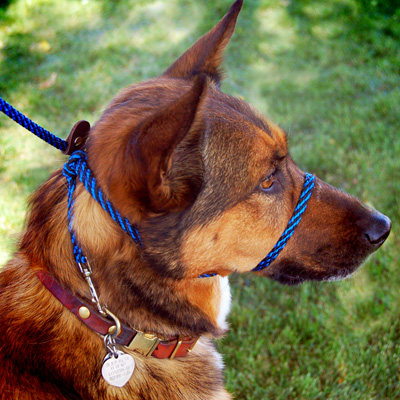
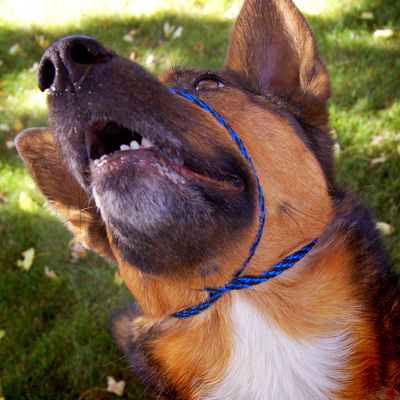
From the website: The Infinity Lead forms a figure eight around the dog’s upper neck and muzzle, crisscrossing under the chin. There is no pressure on the throat. The lead attaches at top of the neck. All-in-one collar and leash design means there’s no leash snap to get in the way, and it’s easy to use!

It looks like this:

cora-profile-rt

The Infinity Lead is one piece, so you basically make a big loop around their head (like a slip lead) and then twist it to loop over their nose. It’s very easy to put on.

cross-under-chin-rt

Then you tighten it by adjusting the slip behind their ears. The leash is part of the deal. You can choose between 4 and 6 foot leash options. It’s all one piece, without any clips or rings:

bold lead design infinity

Here’s what happened with Boogie:

I was surprised by his lack of “woe is me” theatrics. The fabric is much softer and way lighter than that of the GL. That helped. Boogie totally shuts down with a GL, but was  a little looser with the Infinity Lead. Not exactly full of joy, but not walking like he’s 100 years old either. I was happy to see that the second time I brought it out, Boogie didn’t try to hide behind the cat.

To give it a good road test, I brought it dog walking with me for a few days. I tried it out with one of the more reactive dogs I walk who is approx. 50 lbs and wears a Gentle Leader regularly for city walks. On our walks the Infinity Lead did what all head harnesses do: it reduced pulling, gave me better control, and directed my dog’s attention to me for training purposes. So far so good.

I did worry that the Infinity Lead would be too loose and the leash too thin, for walking a really rambunctious dog. Would a dog slip loose of the snout loop, in a  full blown dance-off with another dog? Would I have enough control during a really dicey moment?

While we avoided any major meltdowns, my friend did get worked up at the sight of another dog and tried to kiss a few squirrels. I had the lead fitted very snugly behind my pal’s head and I was pleasantly surprised by how much control I had. When she began to lunge forward, the leash tightened like a regular slip lead, reducing her wiggle room, and I was able to re-focus her attention.

p.s. This slip feature is handy if you need to quickly shut your dog’s mouth for some reason (like when a screaming kid comes running out of nowhere and tries to grab your dog’s tongue out of their skull).

The dog I tested this on has some good training under her belt. If she has enough space, she can stay calm around other dogs. Would the Infinity Lead be the right tool for a large dog with no prior training? My bet is that for straight-up pullers who are non-reactive, the Infinity Lead will be a good option, no matter how big or clueless the dog may be. But if your dog is large and really reactive and/or you’re just starting to work with them, I’m guessing you might need other options in your toolbox, like a more sturdy head harness and leash or, for smaller reactive dogs, a body harness with a two ended leash  might work, for added safety and better control.

Ok, back to what I loved the most about the Infinity Lead: I was connected to my pal at the back of her head, not under her chin. No more Tilt-a-Smush when she switched from side to side to smell stuff. We were tangle-free. It was amazeballs. The sun shone brighter and little birds sat on my shoulder to sing us sweet, sweet songs. I swear.

To be fair, there is another option in the behind-the-head category: the Canny Collar. I’ve tried it, but didn’t like it any more than the GL. Other people think it’s great. So there’s that.

Another thing that ruled about the Infinity Lead: the safety-first cord. The Infinity Lead has a safety-first piece that connects to the flat collar as a back up, in case they slip out of the snout loop. The GL does not have this and that stinks. (yes, the Halti also has a safety-first cord, in case you’re keeping track, but like the GL, the leash attaches under the chin). With the Infinity Lead I loved knowing that no matter what happened, if the loop came off her snout, we’d still be connected because of the extra safety bit, seen here:

lead-on-hazel-rt

There are some other handy features too: it’s one size fits all (for dogs 20+ pounds), so if you have multiple dogs or your dog is still growing, you don’t need different sizes. I can keep one with me and use it on all of the dogs I walk. Yay for adjustable tools.

It also doesn’t have any difficult latches or tiny buckles. Bold Lead Designs makes products for service dogs and they were thoughtful about making this tool accessible to those with physical limitations.

There’s more and you can read all about it here for the complete details. Oh, it’s $19.99 by the way. Totally affordable.

So, if you’re looking for a new training tool to try, I would recommend giving the Infinity Lead a test run. And if your dog fakes his own death at the sight of a GL, well I can’t say for sure how they’ll react to the Infinity Lead, but it is soft and really lightweight. For Boogie, that’s was enough to live for.

Wishing you all Happy, Safe Walks!

** One last thought for shelters: If you’re familiar with the Weiss Walkie, consider the Infinity Lead as a head halter equivalent for your dog walkers. Easy to put on in a kennel, adjustable sizing, all one piece.

*** OK, one more thought. Based on all the comments, their are some strong feelings about head halters out there! So I just want to be clear: I don’t think that there is one item that is the perfect tool for ALL dogs. Every dog is different and I use a variety of head halters, body harnesses, and collars with the dogs I walk. It all depends on their individual needs and preferences. I also use a variety of tools with the same dog, changing them up depending on the environment we’re in. So I might use a body harness in a quiet area, but switch to a head halter in a crowded spot for more control. And the funny thing about ALL of these options is that what one person loves, another hates! So much of it depends on the individual dog and the style/skills of the person when using the tool. The halter in this blog is just one option – I encourage you to shop around until you find what works best for you and your dogs!

Six Tips for Safer, Happier Dog Walking

It’s National Walk Your Dog Week and to celebrate, I got the chance to guest blog for a wonderful nonprofit called Found Animals Foundation.

The folks at FAF totally get DINOS. So they wanted to help spread the message that even though we’re all really excited about Walk Your Dog Week, we still need to remember to be respectful and responsible too.

I love it when the DINOS messages spreads to a new group of dog lovers!

If you’re looking for a polite way to talk to someone you know about their leash problems, my guest blog: Six Tips for Safer, Happier Dog Walking  is the perfect intervention.  Read it here now.

When you visit the FAF blog to read and share it, don’t forget to let FAF know you appreciate them spreading the DINOS message: DINOS are GOOD dogs, they just need space!

p.s. Need something polite and informative to give to strangers while you’re out dog walking? I got you. Check out my pocket-size handouts on Flickr and now available on Cafe Press.

The DINOS Message or All Jacuzzis are Hot Tubs, but Not All Hot Tubs are Jacuzzis*

One of the very cool, and truly unexpected, things about DINOS is how crazy popular the term DINOS has become in the last 10 months. When I was sitting at my desk last year, totally annoyed after a difficult dog walk, and coined the term DINOS/Dogs in Need of Space, it never occurred to me in a million years that DINOS would become a commonly used term to describe dogs.

In particular, DINOS has come to be synonymous with “reactive”, and since I work and live with reactive dogs, that’s pretty ok with me, most of the time. I love that having a term, other than reactive, helps dog owners feel better about their dogs (and themselves). Trainers have told me that talking to owners about DINOS is a way to break the ice about reactivity, without freaking their clients out. Most of all, I love that being a DINOS means you have a team now. You’re not alone if you have a reactive dog: there are so many of us we could stage a DINOS-only Olympics. We would, of course, need a lot of space.

As the term becomes more popular, as it spreads from country to country, I’m starting to see how various animal welfare groups, writers, and other organizations are relaying, repackaging, and relating the DINOS message. It’s very exciting stuff, but it occurred to me that it might be time to have a little pow wow about communication, messaging, and language choices because if we want the dog-owning public to understand and respect our DINOS wishes, we need to consider our messaging.

(p.s. this is aimed at groups or writers who are speaking on behalf of ALL DINOS – not so much about individuals talking about their own dogs.)

Marketing business sales


So, let’s get clear on one big thing:

All reactive dogs are DINOS, but not all DINOS are reactive.

Understanding this will help us to spread the message more effectively.

There are so many reasons why a dog might be a DINOS (for life or just for the day). Let me recap, for anyone new to the blog. A dog might be a DINOS because:

-They are injured

-They are seniors

-They are contagious

-They are working

-They are recovering from surgery

-They are learning how to politely greet other dogs

-They are service dogs

-They are afraid of people

-They are blind or deaf

-They have a medical condition

-They are being walked by a person that is a HINOS (a human in need of space)

Now let me ask you guys something: If you were a MDIF, someone likely to let your dog run up, on leash or off, to an unfamilar dog, which dog would make you more sympathetic, and therefore more likely to listen to the DINOS  message:


A dog that is 16 with bad hips and needs space to avoid injury

or

A dog that is reactive and needs space to stay calm


What about this?:


A service dog who needs space to do her job properly

or

A dog that is fear-aggressive and needs space to keep everyone safe


Now, I know all you DINOS owners will say that it doesn’t matter what the reason is for a dog to need space. They need it and they should get it. Indeed, you are correct!  But being right is rarely the most effective way of changing other people’s behaviors (think: dieting, smoking, wearing jeggings).  If we want to reach the most amount of people with the message that many dogs need and deserve space, we should consider how we market our plea for space.

Here’s my 10 second p.r. lesson on the topic:

reactive dogs = no sympathy

old, injured, one-legged service dog with epilepsy = give that poor baby some space!


This dog clearly needs our help!


Ok, maybe one nice lady will have sympathy for the reactive dog, but how many of you have been told, usually be some dude who’s screaming in your face, that if your reactive dog needs space, you “shouldn’t be out in public with that nasty dog” or “It’s not my problem.” Or we get cursed at and told, “Train your dog!”

People who have never lived with a reactive dog just don’t get it.  But they’re the ones who need to hear our message the most. Which is tough, because they have very little sympathy for our dogs.

As far as they’re concerned, if our dogs are so “bad”, then we don’t have a right to walk them in public. Lost of folks believe that a friendly dog should have the right to go up to any dog it sees. If the other dog doesn’t like it, then they have the problem and shouldn’t be allowed out of the house.

So how do we reach these people – the ones we’re really hoping will hear the DINOS message?  We need to make DINOS sympathetic and more relatable. We need to make sure that the world hears that a dog can be a DINOS for lots of reasons. Many of which are no one’s fault, have nothing to do with training or behavior issues, could happen to them even, and therefore, these dogs have the “right” to be out in public and have space.

Now, don’t get me wrong, this isn’t some sort of attempt to shove reactive dogs into the closet or deny that some DINOS are dog-aggressive.  This is about how to get our message heard by the largest number of people and move them to change their deeply ingrained beliefs and behaviors.

Because if a lot of people get the message, reactive dogs will reap the benefits. It won’t matter to Boogie if someone gives him space because they understand reactivity or if they’re just being polite because they now understand that dogs needs space for lots of different reasons.

Here’s the thing: I don’t think the average dog owner is at all interested in learning about what reactivity is or how it works. Trying to explain DINOS by focusing on teaching the world about reactive dogs is a sure way to lose a sizable chunk of our audience.

On the other hand, if I tell people that Birdie’s back is really sore and she’ll snap at a strange dog who jumps on her: they get it. They’re nice people and they don’t want my old dog to get hurt. Maybe they had an old dog once or are saddened when they think about their own dog aging. If I say the message right, they might even remember what I told them the next time they’re out walking their dog.


I’m old and my back hurts. What’s so hard to understand about that?


So, if you’re like me and you’re trying to get as many people as possible to understand that some dogs needs space, leading with reactivity isn’t the way to go.

If we lead with the message that some dogs are “damaged” or traumatized or have “issues” or something else considered negative, DINOS will likely become synonymous with “dangerous” or “bad” and then, trust me, no one will give a turd about respecting our dog’s needs. They’ll just want our dogs banned/muzzled/etc.

So for everyone out there spreading the message that dogs need space, I’m asking you to consider your words, your messaging, and your approach to relaying this idea to the general public. In order for the message to be effectively heard, we need to capture the public’s sympathy and help them understand that many dogs are DINOS (or will one day become DINOS), and since you can’t always tell just by looking at them, it’s best to give ALL dogs some space.

So go forth, spread the message that there are Dogs in Need of Space. Tell the world that DINOS are GOOD dogs. And don’t hesitate to throw in that reactivity is common and pretty normal. But always remember who your audience is and try to tailor the message to them.

The more people who understand and respect that many dogs need space, the more all dogs will benefit, reactive dogs included.

**Why yes this is a Big Bang Theory reference. Bazinga!
Yellow, But Not Mellow

Author’s Note: I am not responsible for the Yellow Ribbon campaign and it’s not officially associated with DINOS™ or Notes From a Dog Walker.  If you’d like to learn more, here’s the source of the project and the newer Yellow Dog project. Those hard-working folks deserve all the credit – not moi!

While I was away on vacation the other week, I got about ten thousand (give or take a few) emails and Facebook posts about this image:


To say that folks are excited about the color coded system is an understatment – social media is bubbling over with dog  owners who have raided craft stores for yards of yellow ribbon. I’m expecting to start seeing dogs wrapped completely in yellow, waddling down the street like little sunshine colored mummies!

For those of you who missed it, I weighed in on this topic the other month when I wrote about color systems in Color Me DINOS and here’s the short version of what I said:

I think color coded systems are a MUST HAVE for any closed group: dog walking clubs, sporting events, camps, etc. Any place where everyone is on the same page and fully understands what the colors signify. Many groups, like Chicago SocialBulls use a fun combo of bandanas and various flair, to help dog walkers communicate with each other. It’s very effective in a closed group. I totally recommend it.

When it comes to using the color system in public, I say go for it, but with some concerns (see below).

I have no doubt it will help some people  communicate with some strangers while they’re walking down the street. I’m thinking in particular of dogs with medical conditions, like my pal Taz who has epilepsy and needs space from other dogs to avoid having cluster seizures. A color system that can help Taz get the space he needs? Super awesome.

I’d really love to see this work, so I don’t want to be a Debbie Downer, but I do have a few concerns about the color system. Humor me:

1. This won’t do much, if anything, to help us communicate with dog owners that just don’t care. That includes people who ignore leash laws or let their dogs wander loose, people who let their dogs charge into our yards, people who think that our dogs will learn to like other dogs if they just meet their friendly dogs, people who ignore the “Do Not Pet” patches on Service Dog vests, the people who don’t listen to us say “No” now..and others. That’s a pretty big group.

2. This only works if people can see the yellow flag (and know what it means). So if they’re walking up from behind and can’t see the leash, it’s not going to help. Oh and some folks just won’t get it. My friend, who does not have a DINOS, saw this poster and commented that it looks like a poop bag is tied to the leash.

3. So, that means that the color system should be viewed as just one tool in a larger toolbox. If you’ve got a yellow tie on your dog’s leash, don’t assume the people around you can see it, know what it means, and/or care. So we still need to be proactive and on our toes. We can’t rely on a yellow flag to do the work for us. It might work sometimes, it might not. Ultimately, we are responsible for our dogs.

4. Which brings me to liability issues. I’m not sure if it’s the pit bull owner in me  – the one that is extremely wary of publicly declaring my dog might be “dangerous” in some way – but the language in these Yellow Dog posters worries me. If I were behind the Yellow Dog campaigns (some people think it is me, but I can’t take any credit – this isn’t officially associated with DINOS in any way), I’d run my language and messaging by a lawyer. Before I put a yellow ribbon on my dog, I’d want to be 100% sure I’m not making myself liable or seen as negligent if my dog gets into an altercation. (side note: can we please take the pit bull off of this poster? They have a hard enough time as it is. They don’t need to be the face of this campaign).

5. Finally, just because a dog doesn’t have a yellow ribbon on, doesn’t mean he deserves to have strange dogs up in his grill. Which means all of us still have to be polite, respectful, and responsible. Focus on the people. They’re the problem, not the dogs. People need to be responsible for their dogs. People need to learn that they should always ASK before they approach or allow their dogs to approach another dog. The only way to really ensure that everyone gets to safely enjoy public spaces is for people to take responsibility for our dogs and ourselves. You know the drill:

  • Control your dogs, on leash and off leash, at all times.
  • Always ask permission before you or your dogs approach an unfamiliar dog.
  • Wait for an answer.
  • If the answer is no, allow others the space to pass.

No matter what’s hanging off a dog’s leash, if we all controlled our dogs and took a second to politely ask if we can approach, rather than assuming it’s ok, we’d all be doing each other a world of good.

I hope the yellow ribbon campaign is a big help to those of you that decide to try it out. Please let me know what your experiences are, if you do, ok?

In the meantime, I’m going to keep working with my friends at Design Lab (the folks who brought you the DINOS logo) on a complimentary project: we’re creating a poster that reminds people to always ASK, before approaching an unfamiliar dog. Hopefully, between the color coding and a campaign that encourages responsibility and respect for others, all of us with DINOS will get a little relief!

For more info on the yellow dog campaign, see the original source here!

The Inventor of Spray Cheese is My Hero.

Today I splurged and bought myself a veterinary house call.  It was time for Boogie’s annual exam and we’ve been searching for a new vet, so I figured that since we’re switching vets anyway, why not upgrade to an in-house visit?

Last year’s vet visit was a disaster (see: 2011 stink-a-thon) and we figured a visit at home would not only help Boogie feel more relaxed, but it would nice for us too: we have 5 pets and I’m tired of airing out my car for three months after my cats explode in their crates from car sickness. Dude, have you ever tried to get cat pee smell out of a car’s upholstery? Years. It takes years.

The vet was just here this afternoon, so I figured I’d give you guys an update, for anyone following the saga of the wee Boogie.

We didn’t take this vet visit lightly. Prior to today, we’ve been practicing different restraints and approaches to see what’s most comfortable for Boogie and trying to counter condition him to some stuff, like blood draws. Many fearful dogs prefer a blood draw from their rear leg, because it’s scary having people up front, near their heads, but after a lot of counter conditioning (per Sophis Yin’s great resource), Boogie wasn’t getting any more comfortable with it. So we knew we needed to practice restraints for a front leg and maybe a jug draw.

Earlier today, as the clock ticked closer to lift off, I gave Boogie a wheelbarrow of calming treats and exercised him for an hour right before they arrived.

Ok, so picture this: the vet pulls into the driveway.  We started off out in the yard. Boogie was freaked out when the vet and the vet tech (Hi Denise!) arrived. This is something we used to deal with a lot, but in the last year, thanks to lots of practice, he’s started to enjoy meeting new people in the yard. So it was a bummer that it was a rocky start. I’ll chalk it up to being in a new house, since we just moved in a couple of weeks ago and these were our first visitors. 

To let him cool off, we let him hang out with his ball and focused on our other dog, Birdie, for a few minutes.  Birdie loves meeting new people and wanted to show the vet the new cyst she grew on her head. She was really proud of it.

Then we went inside and put Boogie’s basket muzzle on. Boogie needed vaccinations, a blood draw, and a lump inside his ear examined. While he was lying on his bed, getting fed a steady stream of Easy Cheese by me, the vet looked in his ear and gave him one shot, then I picked him up (he was too nervous to leave his bed, but we had to get him on all fours) and placed him between my legs. I loosely restrained him and gave him some distracting-noogies on his forehead while the vet gave him another vaccination in his hip.  Lastly, we restrained him for a front leg (!) blood draw. I rubbed his forehead a lot, feed him more cheese, and told him he was a champ. 


Did I ever tell you, you’re my hero?


Did Boogie growl during the exam? You bet.

Did he struggle or try to get away? Nope.

Did he eat half a can of cheese? Oh yeah. I heard the nozzle sputter and cursed myself for not having a spare can of cheese on hand (rookie mistake). Luckily I had a Lickety Stick handy. Mental Note: don’t cheap out on the spray cheese next time. Buy a case.

After the examination, we took Boogie’s muzzle off and he approached the vet and vet tech with a wagging tail. Not a bad way to end the visit.

Wanna know one of the very best parts? Start to finish, I think they were here for 15 minutes. Normally, going to the vet takes 2 hours (packing them up, driving them there, waiting in the car, the exam, and return trip. Plus post-car vomit, poop, and pee detail.  And then a stress-induced coma nap.

So the fact that I’m writing this to you all right now, while my husband picks up some Thai food, is a victory in and of itself.

But back to Boogie. I really appreciated that, rather than scold Boogie for growling, the vet just kept examining Boogie while I fed him treats. Hopefully, that approach will begin to change Boogie’s emotional response to being handled by a vet. One of these days, Boogie will need more vet care than just an annual exam, and I’m hoping we can start making it a more positive experience for him.

What was the most helpful thing we did in preparation for the visit?  Hands down it was teaching Boogie to love his muzzle.

All the other stuff helped a wee bit, but the most helpful counter conditioning that we did, prior to this visit, was teaching Boogie that his muzzle is the best thing ever. We started by letting him use it as a giant ice treat (aka the Kuzzle), then had him wear it for very short periods, and then eventually for longer lengths of time and during pretend exams, all while being hosed by Easy Cheese.  We’re talking many, many weeks of cleaning cheese out of his muzzle. It wasn’t overnight.

So the end report: Home visits are super great. Get one. It’s like going to spa, only there’s a stool sample involved. And this new vet is welcome back any time. Most of all – muzzles are really handy. Teach your dog that it rains cheese or peanut butter or liver when they wear one.

Oh, and now for the really good news: tomorrow we leave for a  family vacation with the dogs. Boogie earned it and we can’t wait to take him swimming. Here he is on last year’s summer vacation:

See you all in a week!

Color Me DINOS

In the last couple of weeks I’ve seen a post called Swedish Yellow Dog making its way across social media. It encourages dog owners to use a little yellow ribbon on their dog’s leashes to indicate that their dog needs space. People really seem to dig the idea.  And for good reason – it’s a smart idea!

Yellow-Dog

On this side of the pond, my buddies over at Dog Flags introduced a handy color coded system for dogs that covers a variety of messages, from “Friendly” green flags to “Ask Before Approaching” red ones.


red


I’m a big fan of any system that helps people communicate with each other (especially from a distance), so that their dogs don’t have to deal with unwanted encounters. It’s a great way to “talk” to other people about your dog’s needs, without having to say a word.

Dog training centers, dog parks, pack walks, dog competitions and other dog groups have been using the color system to communicate their dogs needs for a long time, typically using red as the color for dogs that should not be approached without permission.

The DINOS logo dog (inspired by my Beagle mix Birdie) is wearing a red bandana for this very reason:

But there’s a little problem: only the doggiest of dog people know what these colors mean.

And only polite dog people care enough to respect the color system.

That’s why they work so well in closed groups, like pack walks or dog camps. Every one is on the same page and working towards creating a positive experience for all dogs. It’s responsible dog ownership and interaction at its best.

It seems that the only way a color coded system will work out in the wilds of the public is if there’s a huge PR campaign launched to educate the average person about the meaning behind the color system and what to do when they see a red or yellow flag.

Oh, and we have to settle on a color. I’m all for red, for DINOS, obvs.

This campaign would need to cross all sectors of the pet industry: dog trainers, vet offices, humane groups, boarding and grooming, pet publications, retail, etc. and would need to be promoted uniformly in a variety of mediums. The message would need to be clear, concise, and consistent. If various companies marketed their own color coded products and kept changing the messaging, it would confuse the public.

And even then, we’d have to be content with the fact that despite a big push, only a small portion of the public will internalize and respect the color system.

We know this because: half of us walk around with t-shirts that say “Keep Back” while our dogs are wearing bright orange flak jackets that read “GET AWAY FROM ME!” and shoot off warning blasts, but yet…people still come over to pet them, while commenting about their ritzy coats. Sigh.

And a color system won’t even put a dent in one of our biggest problems: off leash dogs that are not under voice control or are roaming unsupervised.

It’s a battle we’ll never fully win.

But should we try anyway?

If more people were aware that a dog wearing a red bandana, Dog Flag, or ribbon on their leash needed space and knew they needed to ask permission before approaching, I have no doubt that some dogs would be spared some unwanted interactions with other dogs and/or people.

But I don’t think that any dog should have to wear a color-coded item in order to be treated with respect by others. I’d rather teach everyone to be respectful of ALL dogs. 

So what do you think? Is it time for a color coded PR blast? Will people really get the message or is it just another layer of confusion in this dog-avoids-dog world? Have you tried a color system? Are there down sides to this idea?

December update: The color debate is an international conversation with many pros and cons. At this time DINOS™ is not officially associated with any color system. You can read more about the yellow ribbon idea here.


That’s Cool Dog.

It’s really hot in Maine today, which means it’s scorching in the rest of the country. I’m worried that everyone south of New Hampshire is bursting into flames as I write this.

So for all of you with hot dogs out there, here’s a few ideas to keep them cool today (if you can’t smuggle them into a movie theater for an afternoon of popcorn and ice-cold air conditioning):


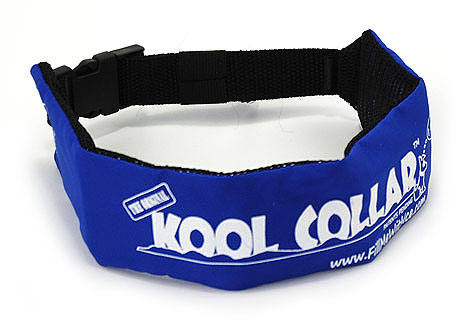
Kool Collar

Fill this collar with ice and keep your dog’s body temp down while you’re out in the sun or stuck  inside a stuffy apartment. Yes, you can wear one too.

KoolCollars_001

Hurtta Cooling Coat 

Soak this  coat in cold water, wring it out, then put it on your dog. Keeps them cool as the water evaporates and it protects them from the sun. RuffWear also makes a similar coat.

Kool Dogz Ice Treat Maker

Keep your dog busy and cool for hours with this hunk o’ ice and toys.  Perfect for shelter dogs in outdoor kennels. You can also make one with stuff around the house. Learn how from Animal Farm Foundation here.

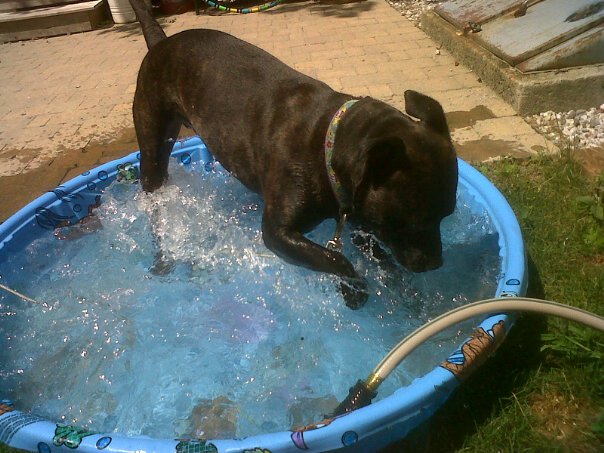
Kiddie Pool

Boogie learned how to swim in a lake last summer, but we can’t get to a lake most days. For M-F swims, I’m all about the kiddie pool. Low tech. High fun.

Other low-tech ideas:

Freeze chicken or beef broth in ice cube trays for a tasty, cold treat. Put a cold, wet bandanna around your dog’s neck. Put some green beans or sweet potato slices in the freezer for a frozen snack. Feed them dinner from a frozen Kong.  Read the Polar Express out loud to them.

What are some of your favorite ways to keep your dogs cool on hot summer days? Do tell!


Dog Bite Prevention Week: How to Safely Interact with Humans

Dog Bite Prevention Week is a favorite of mine –  every year there’s a ton of great advice floating through the interwebs.

Thanks to trainers, vets, and other dog pros, we know how to prevent dog bites: understand dog body language, manage dogs properly, socialize and train them, teach kids how to safely interact with dogs, don’t chain them in your backyard or let them roam unsupervised. Got it.

Here’s one more from me: Get fluent in human body language and communication.

Nothing for nothing, but is anyone else stunned at how often fellow humans completely ignore or miss huge, obvious cues from other humans who are trying to communicate on behalf of their dogs?

You know, the ones that are saying, “Please don’t come any closer!”

So, how come so many of us keep getting closer?

I feel like the dogs would benefit if we humans got better at communicating with each other. In that spirit, here’s my contribution to Dog Bite Prevention Week 2012.


How To Safely Interact with Humans and Their Dogs


Right there! Do you see it? It’s a human walking their dog.

In order to approach them safely, you must observe. Before you or your dog gets closer, let’s look at the human:

What can you tell from their body language and facial expressions?

Start with the eyes. Are they darting back and forth, looking for a way to escape? Are the human’s eyebrows furrowed and pinched? You’re witnessing signs of stress. Do not ignore them.

Scan their bodies and look at their hands. A human that is not comfortable being approached by a stranger will often raise one or both hands towards you. If you see body language such as an outstretched hand, palm towards you, this is a clear signal to stop!  Do not continue approaching.

http://www.flickr.com/photos/stevensnodgrass/3570379993/sizes/o/in/photostream/

credit: stevensnodgrass


Next, focus on their mouth. Is it open? Are sounds coming out? It is not unusual for a human who is feeling trapped to say: “Call your dog” or “My dog needs space.”

Occasionally, humans caught by surprise might have a hard time using their words. In that case, screams, shrieks, and expletives might be used.

Do not ignore these verbal warnings. Do not argue with the human. Do not tell them they are wrong and that it is ok for you to approach them because “All dogs love me” or “It’s ok, my dog is friendly“.

Listen to the exact words the human uses. This is a clear warning.

If you’re still not sure if you should approach, look closely at their feet. Are their feet facing towards you or have they turned to sprint in the opposite direction? When a human is running away from you, they are clearly signalling that they do not want to hang out.

Do not follow them across the street. This is not a game of chase.

In some cases, it can be difficult to read a human’s body language because it is so subtle. But the signs are always there, even if we don’t recognize them right away.

For example: you spot a human standing off to the side of a walking path. They may look relaxed, but study them at a bit closer. Are they standing in front of their dog? Are they giving their dog treats as you pass? These are signs that the human is busy working with their dog.

Tip: When someone sees you and then turns away from you, they’re just not that into meeting you.

But what if the human is hiding, you ask? Should I approach them then?

If you spot a human hiding behind a tree, car, or telephone pole. Do not make eye contact. Continue walking. Pretend that you do not see them and their dog. This human is cornered and making one last attempt to escape. If you approach you will be forcing them into a situation where they might feel trapped and bite you. Keep moving.


200255026-001

This person is not into you.


Sometimes we can’t help but have an encounter with humans and their dogs. If that happens to you, please do the following:

Do not flail your arms or shout.

Control your dog, so that they cannot approach them.

In a calm voice, always ask: “Can we meet your dog?” or “Is it ok if I say hello?”

Wait for the human to respond.

If they say no, do not force the situation. The human has clearly expressed a desire to be left alone. Do not ignore these signals.

Give them enough space to pass and keep moving.

Phew. That was close.


Well, there you have it folks. The last piece of the Dog Bite Prevention puzzle: Human Body Language. If we just pay a little more attention to each other’s signals and respect each other’s space, we’ll be doing our dogs a real solid.


Stuff Your Dogs Should Wear If…

I like to put stuff on dogs. I try to find real, legit reasons to put stuff on them, but sometimes, I just like to wrap dogs in towels and put their paws in my husband’s Doc Martins. So sue me. One of my favorite stuff-on-a-dog site is Trotterpup. Please enjoy it here.

All silliness aside, there are some really helpful things to put on your dogs.

So, in no particular order, here’s a list of  Stuff Your Dog Should Wear If…

They have a lot of energy: Backpack

If your dog is high energy and healthy enough to carry some weight, consider a backpack. Wearing a properly fitted backpack, loaded with a couple of soup cans (and by soup, I might mean beer), will help your uber energetic dog work twice as hard on the same stretch of terrain. That means you don’t have to work any harder, but your dog does. Nifty, eh? If you have one of those never, ever tired pups, the added weight will help them burn more steam and tire them out faster during your regular walks. Make sure to start off slow – introduce the backpack first, then add the weight gradually and top out at 25-30% of their body weight. Backpacks are also helpful: if your dog is calmer when they’re wearing their “working” gear, for turning your dog into a sherpa on hikes, and for carrying around litters of hitchhiking kittens.


They need a confidence boost: Thundershirt

thundershirt

If your dog is afraid of thunderstorms then a Thundershirt makes a lot of sense, no? But these slim-cut tops are also good for helping dogs feel more secure, which makes them helpful for some reactive, anxious, and fearful dogs. So don’t keep the shirt on hold for storms and fireworks, go on and bust it out for daily dog walks too. Thundershirts are also helpful: if your dog needs some help during vet visits, for dogs that need barf bags during car trips, and for creating a svelte silhouette for dogs who are self-conscious about their pooch.


They need skin protection: T-shirt

If your dog sunburns easily, try covering them with a t-shirt (in addition to dog sunscreen) to give them some extra skin protection. Or if your dog has environmental allergies, consider putting them in a t-shirt for their trips outside. When you go back inside, take off their t-shirt and you’re taking off the pollen or whatever else they’re allergic to with the shirt (wipe them down with a damp cloth too). If your dog is really itchy or has a skin infection, try putting them in a t-shirt to protect their skin from their teeth or nails. Healing skin needs air too, so be sure to take it off and let them be nudists on the regular. T-shirts are also helpful for: telling people to back off, covering up big nips on mama dogs, and hiding a bad hair day.


They are your co-pilot: Doggles

If your dog likes to hang their head out of your car window, Doggles will protect their eyes from flying debris. That pretty much sums it up. Doggles are also helpful for: dogs that ride in side cars, dogs that are blind and walk into things (it protect their eyeballs), and for any dog that likes attracting a lot of attention at stop lights.


They are scratching themselves raw: Baby Socks

If your dog has bad allergies and they’re scratching themselves to pieces, try covering their paws with baby socks. Allergies can take a really long time to sort out (both the cause and the solution) and dogs who are itchy will sometimes scratch their skin into ribbons, causing secondary skin infections. Try covering their paws with baby socks (size 0-3 months with sticky tread on the bottom usually works), then secure the socks to their ankles with no-stick vet tape. They’ll still scratch, but their covered nails won’t cause so much damage. Baby Socks are also helpful for: dogs that chew their paws, broken toe nails that are healing, and for dogs that can’t stop reenacting that scene from Risky Business.


They just had surgery: Pro Collars

pro collar

If you have a dog that is recovering from surgery, the vet may send you home with the plastic e-cone of shame, but most dogs can’t stand them. It messes with their peripheral vision, scrapes against things, and freaks them out in general. Plus, it’s cheap plastic that probably smells and feels yucky. If your dog will need to wear a cone for a bit, like after ACL surgery, buy a Pro Collar. It looks like a hemorrhoid cushion or a neck rest for travelling (are those the same things?) but it works. The best part is that your dogs can still see in every direction, they can pick up toys and food, and it’s comfy for them to rest their heads on while they sleep. For dogs that are afraid of a regular cone, this is much less scary. Pro Collars are also helpful for: dogs that have rashes they shouldn’t be licking, little dogs that squeeze through fences, and dogs with hemorrhoids who need a soft cushion to sit on.


They need to get adopted:  Tutu

Peaches the Pit Bull Photo Credit: Keith Kendrick

If  you have a foster dog or a shelter dog that isn’t getting a lot of interest from adopters, put a tutu on them and take them out on the town. Ridiculous though it may be, that dog is about to get more attention in one walk than it has in a month of “adopt me” vest outings. Be sure to bring business cards with your dog’s photo and info to hand out to anyone who stops to swoon over your pup. Yes, this is for boy dogs too (who cares about gender? this is about getting attention!). Tutus are also helpful for: dogs in parades, dogs doing humane education work with kids, and dogs that dream of starring in the Black Swan remake.


And that’s not all! There are muzzles, wigs, boots, sweaters, and plenty of other stuff dogs can wear.  I already feel a Stuff Dogs Should Wear If (Part 2) coming on…

What stuff does your dog wear? I want to see photos of them wearing their favorite stuff, so post photos over on the DINOS Facebook page for me to squeal at. Please?!