Skip to content

Big Red Ball: A Love Story

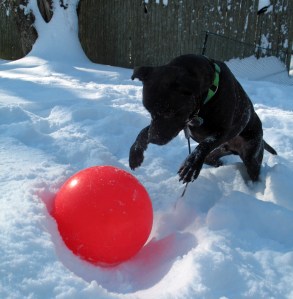
Throughout the years, there has only been one toy Boogie hasn’t eventually destroyed. Today we’re sad to report that this toy, the Almost Indestructible Ball, is no longer available at most stores.  We’re tipping our forties in its honor.

Luckily,  he doesn’t need a new one just yet, since they last Boogie a few years, but one day it’ll be so beat up that he’ll need a replacement. Sigh. Then we’ll have to go in search of a new lover ball.

There’s the front runner: the Jolly Ball (just make sure you get the one without the handle: Boogie ate that right off). And a couple of others to try, like the Boomer Ball (good enough for hippos at the zoo!) and a new Indestructible Ball. But it won’t be the same to Boogie.

He’s feeling kind of blue about this, so he wrote a poem.


Ode to My Big Red Ball

By Boogie “The Nudge” Dolce


Today it snowed.

Mom will release you

from your Home Depot Bucket.

The one with the lid

I cannot get off.


They hide you from me because

I forget to poop when you are near me.

No matter how long I am outside

I don’t go.

I would never leave your side

To make a stinky number two.


There you are

Big Red Ball!


Thump!

My chest bumps you along the ground.

Boom!

I slam you into the deck.

Wack!

I crack you against the trees.


My paws try to pull you closer,

then they spaz

out of control,

Pushing you away.

I didn’t mean it –

Come back!


Mom calls me inside,

I cannot hear her

over my love for thee.

You make me squeal

like a crazy chicken-piglet.


I want to lie down and

chew you into pieces so bad.

But you taught me the meaning of

Tough love.

My Almost Indestructible Ball.


How to Exercise Your Dog Without Leaving the House

Some days, you just don’t want to walk your DINOS.

Maybe it’s because the weather is terrible, like the freezing rain we had here in Maine last week, or it might be because your neighborhood is filled with off leash dogs that terrorize you on your walks. Most of the time, we still grab our leashes and hit the streets, but there are some days we could all use a break.

So whether you’re looking for a safe way to exercise your DINOS without running into other dogs or you just want to avoid extreme weather, here’s a bunch of great ideas for indoor fun from Team DINOS on Facebook!


To get us started, here are some of my favorite ways to wear out dogs inside the house:

treadmill

Treadmills: They can be total lifesavers for DINOS.  With a treadmill you can safely exercise your DINOS in your home, with no other dogs to contend with, whenever your dog needs it. You can use the treadmill you already have, purchase a used one for cheap off of Craig’s List, or a buy treadmill specifically designed for dogs. Here’s some advice from Bad Rap for getting started with a dog-powered (no motor) treadmill.

Puppy Push Ups: Sit, down, sit, down, sit, down. Easiest “trick” in the book. It helps burn off a little energy, even if your dog only knows two commands!

Feeding all Meals from Frozen Kongs: If your dog has a lot of energy, I would suggest chucking your dog bowls all together and only feeding from dog puzzles. Firecracker Dogs has some great articles on this and a store filled with puzzles that are worth checking out. If you’re using Kongs, try freezing them, since it’ll take much longer for your dogs to work out their meal, burning more mental and physical energy in the process.

Rile/Recovery work with a Flirt Pole: You can go the homemade route or buy a premade “chase it” toy, but either way, if you have a dog that loves chasing stuff (and has healthy joints), this giant cat toy will rock their world and burn a ton of energy. What’s key to this? Your dog must know basic commands such as: sit, down, wait, take it and drop it for this to be a safe, fun game.  If you want to do this inside, get a smaller 2-3 foot flirt pole, for outside, you can go big! Before you try it, take a look at this video from Bad Rap and read this how-to.

Heavy Duty Chew Toys and Bones: Some dogs can work out an incredible amount of energy through chewing on toys and bones. Particularly helpful for barkers, to wear out those overactive jabber jaws.

Those are some of my faves, but don’t stop here, check out all the great suggestions from the rest of the group (keep in mind that all dogs are individuals and what works for some, may not be the best choice for others):

Heather Masch Nosework is a great activity to do indoors.

Juli Thompson Casey and I play hide and seek. She has to sit and stay while I go into another room, or closet, maybe hide behind a curtain. When I yell “come,” she has to follow my voice to find me. Body and brain both get exercised, and it reinforces “come,” which is still a problem command for us.

Lori Fricks I throw a tennis ball up the stairs, Marshall chases up after it and brings it back down for another go! We also play tug until my arms go numb!

Jo Maisey I do some clicker training to tire out their brains.

Ashley Oslund Laser light in small doses!

Kim Kusznir Odin likes to jump in the air and pop bubbles!

Alexis Bywater Laser pointer!! Keep “dot” sessions short and sweet! 10 minutes with the laser pointer can be a great workout (I combine obedience work with laser play which is a great way to proof commands on a really amped up dog).

Kristel Smart I live on the fourth floor of an apartment building and our stairs are indoors and carpeted. The stairway tends to be pretty deserted (most people prefer the elevator) so I practice send-aways and emergency stops and downs while I have Murphy run up and down the stairs (he has great hips and he’s young). When he’s tired out I let him relax with a good rib-bone.

Kelsey Gidley We play the box game, dinner from puzzle toys and lots and lots of tug.

Suzan Toscano Tug toys & balls thrown down the hall to be retrieved.

Julie Parker Rmdt We play “tag” in the living room. We also like the Kong Wobblers for mental stimulation.

Kathie McDermid Dierk Throw the ball, throw the ball, throw the ball…and then maybe “find it” (he sits in another room, I take a treat, hide it (like in a drawer or something) and then release him to “search”)

Kendra Roering Treadmill!

Jennifer Whitton-Trujillo We throw the ball (or whatever other toy Colby brings), but I love throwing it down the stairwell, so he has to run up and down stairs. Wears him out much better than just tossing it down the hall!

Jessie Copeland We play fetch in our kitchen with light plastic balls or a Kong frisbee, trying to continue basic drop, sit, stay, and other commands. Dash LOVES this game!

Judy Michaels Living Room Rally! My fave: One dog becomes a post, and a little yellow cone the other. Great way to work on Figure 8s and distraction work!

Barbara Lewis I don’t have stairs, so I set up a makeshift agility jump (broom held up about 6 inches off the ground by stacked books or whatever else) – then I toss pieces of dog food across the room so she has to run and jump over the hurdle to get it. It’s sort of ridiculous, but it works!

Laurie James Buchele Puzzle toys, brain games, tricks.

Laura Pescador Misha has the big egg-shaped FitPaws ball for strength and stretching, nosework, recall games with one human holding her and the other hiding, the big box home improvement store up the street still allows dogs (early on a weekday before work there aren’t a lot of other dogs), lots of training games like calling heel from anywhere in the house.

Brooke Palmer Lots of puzzles and messing around with the clicker to see what I can try to get my dog to do.

Violet Elder Run her up and down the stairway.

Celeste Schmidt We’ve had an oddly warm winter this year, but usually good ol’ tug, some shaping, nosework, and treadmill are what help. I’ve also had to jog in circles inside the house, usually I’ll have the dogs come along with me.

Michelle Doram K9 Nose Work!

A Better Life with Your Dog with Fernando Camacho I have done a number of sessions with dogs that become obsessive shadow chasers because of laser pointers, so my favorite indoor fun is bubbles. My dog will jump and pop them for hours. Great exercise!

Laura Elizabeth Mine loves to play tug game, so we play tug of war and some fetch inside.

Jill Michalski Hide n’ Seek, “Find it”, Kong Wobbler, and sometimes a bit of “doggie boot camp” practicing sit/downs (like doing pushups), stay, wait, place, etc.

Jennene Lausier My dog loves our treadmill! It’s his favorite!

Kris Hopkins My last German Shepherd police K9 was the “diggiest dog”. To channel it in non-destructive ways I bought him a small, thin heavy-duty crate bed and let him scratch it from one end of the room to the other. He was totally winded scratching at that scratchy pad for hours! When we could go outside, he got a sand box and it was the “dig patch”. All other areas were off-limits for digging or scratching. It worked and his front legs were unbelievably strong!

Jackie Hall-Reigle I had bought a treadmill for him and surprisingly he got right on it! He loves it, and when he hears it start, he comes running to get on it.

Sarah Power We hide toys while she waits in another room. We put the toy in a taped up box so she has to get it open, also bring out the agility tunnel to jump over and hide stuff under laundry baskets. Mental stimulation goes a long way, she doesn’t get tired without it.

Anne Davidson Indoors treiball (learn to get it out of corners); jump over boxes, legs both directions for fetch a toy. Sit and watch me hide toys (in sight at this point), then go fetch and put each one in the box. Boxes within boxes; prize inside smallest.

Jessica Healy We play fetch and chase up and down the stairs and also brain games.

Bonnie N. Davis Leo’s still too reactive to play inside, but has a mega thick coat, so he gets lots of trips outside during the day. But when he comes in or if it’s too frigid for him to stay out, he gets a huge bone or toy to chew.

Heather Staas Indoor frisbee with lids!

Lynda McLellan Susan Garrett’s Recallers (online classes) is all about games and most can be played in doors. Teaches self-control and focus while having lots of fun. I also use a Kong wobbler and hide and seek, which my son loves to play with the dogs along with Recaller games.

Danielle Cyr Nose works! Only need one room and my household junk! We also do small space shaping for competitions like retrieves, positions, rear end awareness. Keeps their brains warm!

Martha Knowles For some indoor thinking games and great ways to bond with your dog Playtime for Your Dog: Keep Him Busy Throughout the Day by Christina Sondermann

Jill Petro After tossing a toy or ball for a while, my dog is placed on a stay in another room while I hide the toy. Then I ask him to find it. Makes him use his brain!

Chris Jones We play hide ‘n’ go seek. I put my dog on stay and go hide then I call him. Sometimes he can’t find me and is extra overjoyed when finds me.

Cheryl Copenhagen Set up jumps or the tunnel and throw Kirby’s toys so that he has to jump over or go through!

Nicole De La Perrelle I pull out a couple of books and try to teach something new! Kyra Sundance’s books are good for this, so the other week (when it was hot here in Australia- over 40 degrees Celsius), I put treats in a few cups of a muffin pan and then put a tennis ball into each cup of the pan, so the dogs have to sniff out the treats, then use their nose or paw to push the ball out to get the treat. We also play “fishing” by hooking up a toy on a string to a stick and then flicking it around, getting the dog to chase it, try to catch it etc. You can buy toys like that or use a cat toy (Max loves the feather boa on a stick type of cat toy) or make your own. We also play “rev up and calm down” as part of the inside games.  We get the dogs really excited about the game, but then ask for a sit or a drop and wait for a bit of calm before continuing. This stops the games from getting too intense and the dogs from getting too excited. It’s really hard work so wears them out more!

Virginia HappyGirl Johnson We run up and down the stairs. She made up that game when she got the “zoomies” one night, and we’ve played it ever since.

Alison Garfat  On the rare day we don’t get at least a bit of outside time, Monty gets to learn a new trick – over the last couple of stretches of bad weather he’s learned “back up”, opening a cupboard door (“open”) and closing a cupboard door (“push”). Luckily he’s too short to reach the cookie cupboard! Playing “find it” is also a bad weather staple.


Thanks for sharing everyone!
 

Safe Communities Begin with Responsible People

Note: I originally wrote this for StubbyDog to educate the public about the failings of breed bans, which are frequently proposed after a human has been seriously hurt or killed by a dog. 

Breed bans lead to a false sense of security, because it’s impossible to accurately determine how safe a dog is (or will be) based solely on looks or breed.  The real cause behind dangerous dogs?  People. It’s always the people.

How does this tie in with DINOS? Because we all suffer when people fail to act responsibly. Everyone with a DINOS has had negative encounters with unfamiliar, uncontrolled dogs. It’s almost always due to the irresponsible actions of another person who is not properly managing their dogs. 

Sometimes it’s minor: a friendly, loose dog that chases another dog with no contact. And sometimes it’s major: an abused, starved dog is chained in their neighborhood and gets loose, seriously injuring a person.

The most effective way to create a safe community, and prevent negative encounters with dogs (major and minor), is not by banning dogs based on looks or breeds or labels – it’s by creating and enforcing breed neutral laws that hold humans accountable for their dogs.  

People acting more responsibly would be pretty awesome for all of us.

Checklist for a Dangerous Dog
By Jessica Dolce

Originally posted on StubbyDog


Photos by Melissa Lipani

Are you a politician or resident in an area where a dog-related injury or fatality has recently occurred? If so, you’re probably working to determine the best way to prevent this sort of tragedy from happening again. Right now it may feel like dogs are posing a large threat to your community, but what you’re experiencing is actually quite rare. Dog bites are at historic lows in our country and, as a whole, we’ve never been safer. But there are certain criteria that are consistently present in regards to dog-related injuries, so as you look at the details of the tragic events in your community, here’s a reference checklist for the ingredients that, when mixed together, have the potential to create dangerous dogs.

First, take a look at the function of the dog. Is the dog a member of the family? Keep in mind that just because a dog lives with a family doesn’t mean it’s a family dog. Determine why the family owns this dog. What purpose did they intend for the dog to serve?

Was the dog used for:
_Fighting and gambling?
_Protection of property or other people?
_Intimidation or status?
_Backyard breeding?

If you’ve checked any of the above, you’ve determined that the dog is not a family member. Now it’s time to look at the conditions the dog was living in. Family dogs are provided with basic care, such as food and water, regular vet visits, and time inside a home where they can socialize with their human family members. Take a look at the dog’s daily life.

Was the dog:
_Starving?
_Isolated?
_Chained?
_Suffering from untreated medical problems or injuries?
_Intact (and not being shown or bred responsibly)?
_Not vaccinated?
_Living outside or in a garage full time?
_Abused or neglected?

What did you discover? If you checked any of the above, then you know that the dog was not provided basic care and may, in some cases, have been physically abused. These are further indications that the dog was not a family dog and was the victim of mistreatment.

Next, examine the people involved. The actions of a dog are always directly related to how they are managed by humans. Did the dog owner act in a reckless manner by creating scenarios where a dog, confronted with situations without proper management by humans, is likely fail?

Did the owner:
_Allow the dog to roam freely?
_Fail to supervise the dog around children?
_Fail to socialize the dog with people?
_Have multiple unsocialized dogs?

If you’ve checked any of the above items, then you’ve determined that the dog was not properly managed by its owner. The human set the dog up to fail.

Lastly, look at the history of the dog owner. When tragedy strikes, most people are slow to take responsibility for how their actions contributed to the problem. They may say they’ve done nothing wrong, but since you’ve looked deeply into their daily life with the dog(s) involved in the incident, now you can trace their history. It’s likely that this isn’t the first time the owner or their dogs have encountered trouble.

Does the owner:
_Have a history of criminal behavior?
_Have past citations with animal control?
_Not have a current license for their dog?
_Have a history of training their dog to be aggressive?

If you checked any of the above, then you’ve determined there was a history of reckless behavior on the part of the owner and a failure of law enforcement and/or animal control to follow up on a known problem.

Every one of the items in this article is a warning sign that went unchecked for some time until a serious incident occurred. Luckily, the overwhelming majority of dogs that are victims of one or more of the criteria listed here still do not cause harm. We are safer now than ever before.

So, what’s missing from the list? The breed of the dog is not a checklist item. That’s because any dog, of any breed or breed mix, can become dangerous in the hands of a reckless, irresponsible owner. Sadly, in the last few decades, abusive and neglectful humans have gravitated towards pit bull type dogs because false information and sensationalized myths, from various sources, have glamorized pit bull type dogs as status symbols for criminals.

Just like any other dog, if pit bulls are not treated as family dogs, then they become canine victims, set up to fail by humans that care little about their health, training, or for that matter, the law. If you choose to ban pit bull type dogs in an attempt to make your community safer, these reckless humans will move on to another breed (like they did earlier this century when they chose to own German Shepherds or Dobermans) or it will simply push their pit bulls further underground, hiding from the law, where they will go without medical care and proper socialization.

Now that you’ve looked at the checklist, it’s plain to see how those circumstances, exacerbated by a breed ban, could create a dangerous dog. It is time to move away from fixating on the breed if you want to create safe, humane communities. Instead, focus attention on the elements present in this checklist, since it’s the cocktail of human-related criteria listed here that is to blame.

By addressing these items through the creation and enforcement of breed-neutral dangerous dog laws which address reckless owners, you’ll be creating truly safe communities, without punishing the millions of families with pit bull type dogs that are loving, law abiding guardians of family dogs.

Sources:
Bad Rap
listing out warning signs – a media first?
StubbyDog
When Dogs Bite
The Cruel Cost of Breed Specific Legislation
Animal Farm Foundation
Resident Dog vs. Family Dog – What’s the Difference?
A Community Model For Responsible Pet Ownership
American Society for the Prevention of Cruelty to Animals (ASPCA)
Dangerous Dog/Reckless Owner Laws
National Canine Research Council (NCRC)
What is a dog bite?

Download the PDF

Retractable Leashes: Handy Tool or Fifteen Feet of Doom?

Meeting a ROAR (Rover on a Retractable), can be a nightmare for other people walking their dogs, especially DINOS. ROARs are often 10-15 feet away from their owners and this makes it difficult for us to step aside and let them pass without our dogs interacting.

From a distance it’s super hard to determine if the incoming dog is on a retractable or off-leash all together. I’m not a big fan.

flexi lead

My own personal experience with retractables varies from just fine to pretty awful. I walk some small dogs on retractables and I have no problem keeping my tiny DINOS close, I lock the leash when we pass others and I let them roam when we’re alone. I do my best to use the leash correctly and follow common sense dog walking etiquette, the same as I would with a flat leash.

But, I’ve also had really bad experiences with them. I’ve burned my hand trying to grab at the leash when the braking mechanism failed. And worse, my fear reactive DINOS, Boogie, was attacked by a ROAR.

Picture this: there we were strolling on the sidewalk, when a very large dog, standing in his driveway on a retractable, began to chase us. The weight of the dog running at full speed snapped the bulky handle right out of his surprised owner’s hand. The dog ran towards us, bulky handle scraping on the sidewalk, making a terrible noise. He jumped on top of Boogie, biting him on the head. Boogie didn’t fight back, but he did curse at the other dog pretty loudly. The man who owned the large dog was afraid to step in and help me because he had another dog, also on a retractable, and didn’t want to drag that dog into the chaos. It took a third person to step in and get the dog off of Boogie.

Would this have happened if the dog had been on a flat leash? Maybe, but I honestly doubt it. It was the force of the big dog hitting the end of the line at a full sprint that snapped the huge plastic handle out of his owner’s hands. It was the crazy sound of the handle crashing behind him that amped the dogs up even more. It was the lack of a flat leash to step on, to safely pull his dog away, that kept the tussle going because there was nothing to grab onto (the giant handle was left dangling a foot or so off the attacking dog’s neck).

Do I think retractables should be banned? Nope.

Do I think they have a place and that place isn’t highly populated areas? Yep.


In addition to the control issues, the problem is that, no matter how skilled you are at using them the equipment is known to fail. I’ve worked in pet stores and seen them returned, over and over again, for snapping. I’ve had the breaking mechanism fail on me. And that’s why Consumer Reports wrote that delightful article on finger amputations.

But these leashes aren’t going anywhere, so in the interest of exploring the more (and less) responsible methods of using retractables, I’ve compiled a DO and DON’T list (available as a pdf, minus this whole intro, for easy printing).


A Guide for ROARs (Rovers on a Retractable):

Retractable Leash Etiquette


DO: Be aware that retractable leashes have a reputation for breaking, snapping, and otherwise failing.

DON’T: Let your dog’s retractable get tangled around another dog’s body. The friction from the moving tape or string can cause serious injuries.

DO: Lock your leash to 6 feet or less while walking your dog in public around other dogs and/or people (not all people want to be approached by your dog).

DO: Use them in unpopulated areas, such as the woods or your own back yard.

DON’T: Use them with a gentle leader or other training tools. The point of those tools are generally to teach your dog not to pull, to engage with you, or for better control. It’s a confusing message to a dog to be on both a retractable and a head harness or corrective collar at the same time.

DO: Purchase the best quality retractable you can afford. Typically the tape ones are stronger than the string ones.

DON’T: Expect to teach your dog to stop pulling while using these. Your dog is enjoying pulling ahead and wandering off.

DO: Work on your dog’s recall at other times, so that you’re not just relying on the leash to gather your dog back.

DO: Be aware that those bulky handles are difficult to hold on to if your dog hits the end of the line at full speed.

DON’T: Let your dog wander off while in public places like the pet store or at the vet’s office. If your dog can walk away from you, into another aisle or across a room, the point of using a leash (for management) has been defeated.

DO: Consider them a potentially useful tool for environmentally fearful dogs, dogs that are semi-feral with humans, or other dogs that may need some extra space while they are building confidence.

DON’T: Drop the leash, especially if you’re working with a fearful dog. The bulky handle “chases” behind them, making a terrible scraping sound on pavement, further terrifying the dog.

DO: Be aware that Consumer Reports notes that people have suffered serious injuries, including finger amputations and bad burns from retractable leashes.

DON’T: Walk your large reactive dogs on retractables in any place you may encounter their triggers. It only takes a second to miss the opportunity to lock the leash and then you’ve got a thrashing dog, fifteen feet ahead of you.

Printable PDF is here: A Guide for ROARs

You Know You’re Living with DINOS™ When…

Ah, life with DINOS! It’s filled with quirks,  isn’t it? If you live with DINOS you’re actually part of a super cool group of humans. I like to call them Team DINOS. We’re willing to do all kinds of oddball stuff in order to enjoy safe, happy dog walks. Are you part of the team?

You know you’re living with DINOS when…


Your dog walking equipment consists of a leash, poop bags, high value treats, a cell phone, and…a head lamp, so you can walk your dog before the sun comes up.

You’ve caught yourself browsing for Direct Stop on your lunch break.

You drive your entire dog walking route, to search for any trouble spots, before going for a walk.

The unexpected sound of keys jingling makes your stomach do a back flip.

You know what a Happy Muzzle is and think they’re super cute.

Blind corners are scarier than a Hitchcock movie.

You’ve considered adding “excellent horizon scanner” to the skills section of your resume.

You’ve stood around, pretending to admire someone’s mailbox, while trying to keep enough distance between you and the slow moving dog ahead.

You’re considering teaching your Great Dane how to use the toilet.

If you win the lottery, you’re buying a private dog park.

You’ve criss-crossed the same block more than three times to avoid other dogs.

You have a preference for the kinds of cars you like to hide behind.

Your hamster’s exercise ball is starting to look like a good idea for your dog, if only you could build one large enough for your Lab.

You know where all the fenced-in baseball fields, tennis courts, and other non-dog park spots are located. And you go there at 10 o’clock at night.

Your neighbor hasn’t looked you in the eye since “that time” you told her where she could stick her roaming off leash dog.

You day dream about what kind of privacy fence you’re going to install.

You’re excited to walk dogs in the rain or snow, since bad weather means fewer dogs to bump into.

You’ve whispered “be very, very quiet” to your dog, as you tip-toed past a sleeping dog in a yard.

You’re not afraid to jump a fence, squeeze behind a dumpster, or cut through someone’s back yard to avoid an oncoming dog.

You think Plastic Man and Inspector Gadget were on to something with those extra long arms. Perfect for catching off leash dogs at a distance! 

You bought equipment for a home gym, but you already have a gym membership. The treadmill is for the dog.

On your walks, you wear poop bags on your hands, like mittens, so you can scoop and run.

You’ve got your trainer, your vet, and animal control on speed dial.


What else? Share the quirky stuff you do with your DINOS in the comments section!

DINOS™: A Manifesto

It is our position that DINOS (Dogs in Need of Space)™ are good dogs with the right to enjoy walks in public without the harassment of other dogs and their people.

Therefore we demand the following from our fellow dog lovers:

  1. Obey Leash Laws: Outside of a dog park, or otherwise sanctioned off-leash area, you must leash your dogs. This is not our opinion, it’s the LAW.
  1. Ask Permission Before Approaching: Stop moving and ask, “Is your dog friendly?” or “Can my dog say hi?”
  1. Listen to our Response: Give us time to respond. And no means no.
  1. Respect Our Space: If we move to the side, so that you can pass, do not let your dog approach us. Please shorten their leash and continue walking. It’s not rude, promise.
  1. Do Not Give Chase: If we abruptly turn the other way or cross the street, we do not want to interact with you or your dogs. Yes, we saw you.  No we don’t want to say “hi”.
  1. Lock your Leashes: If you walk your dog on a retractable leash (aka a Flexi Lead), please retract and lock your leash, so that we may pass by without engaging with your dog. Better yet, skip the retractable and use a flat leash. Retractable leashes break.
  1. Zip it: Keep your judgments and nasty comments to yourself. One day, due to illness, trauma, or other circumstances, you too may find yourself the loving owner of a DINOS. Until you walk a (paranoid) mile in our shoes, we implore you: If you don’t have anything nice to say, just keep on walking.
  1. No Matter How Nice You Are, the Rules Still Apply: You may think that because you and your dogs are really nice and very dog savvy, that it’s ok for you to break these rules. Look, we believe you. You seem really nice and so does your dog. We wish we could meet you under other circumstances, but trust us, we know our dogs better than you do. We reserve the right not to interact with you, no matter how nice you are.

In return, the DINOS pledge to uphold the following standards:

  1. We will always leash our DINOS when out in public.
  2. We will muzzle our DINOS, if necessary.
  3. When it is possible, we will always create distance between your dog and our  DINOS, so that you too can pass us without incident.
  4. We will tell you our dogs are DINOS. No mind reading necessary.

Subsection 4A: Don’t Deny Your Dog is a DINOS.

DINOS Deniers are wide-spread. They refuse to believe that their dog is one of the following: inappropriate, rude, or aggressive.  They fool unsuspecting dog owners by saying their dogs are friendly, but in reality they are not. Typically, after an incident occurs, they admit it has happened before, as in: “I don’t know why, but my dog almost always bites when he’s at the dog park.” Stop denying the truth.  You have a DINOS and you owe it to your dog and everyone else’s dog to create safe interactions. If you own DINOS, you must be responsible for understanding your dogs.

DINOS, The Time to Take Back Our Space is Now!

DINOS Unite!

printer friendly pdf: DINOS Manifesto

Looking for a Kinder, Gentler Manifesto? If you’re a shelter, trainer, or just a really nice person, check out this less snarky version, with printable pdf!

photo credit: Ginger Monteleone Photography

Who’s who?

DINOS: Dogs in Need of Space™

MDIF: My Dog is Friendly™

OLDS: Off Leash Dogs™

ROARS: Rovers on a Retractables™

http://notesfromadogwalker.com

DINOS © Copyright Jessica Dolce 2012

DINOS Dogs In Need of Space© Copyright Jessica Dolce 2012