Now Showing: The DINOS™ Movie!
What are DINOS and what do they want? Find out in the new DINOS Movie!
Jan 11

What are DINOS and what do they want? Find out in the new DINOS Movie!
Jan 9
Note: I originally wrote this for StubbyDog to educate the public about the failings of breed bans, which are frequently proposed after a human has been seriously hurt or killed by a dog.
Breed bans lead to a false sense of security, because it’s impossible to accurately determine how safe a dog is (or will be) based solely on looks or breed. The real cause behind dangerous dogs? People. It’s always the people.
How does this tie in with DINOS? Because we all suffer when people fail to act responsibly. Everyone with a DINOS has had negative encounters with unfamiliar, uncontrolled dogs. It’s almost always due to the irresponsible actions of another person who is not properly managing their dogs.
Sometimes it’s minor: a friendly, loose dog that chases another dog with no contact. And sometimes it’s major: an abused, starved dog is chained in their neighborhood and gets loose, seriously injuring a person.
The most effective way to create a safe community, and prevent negative encounters with dogs (major and minor), is not by banning dogs based on looks or breeds or labels – it’s by creating and enforcing breed neutral laws that hold humans accountable for their dogs.
People acting more responsibly would be pretty awesome for all of us.
Checklist for a Dangerous Dog
By Jessica Dolce
Originally posted on StubbyDog

Photos by Melissa Lipani
Are you a politician or resident in an area where a dog-related injury or fatality has recently occurred? If so, you’re probably working to determine the best way to prevent this sort of tragedy from happening again. Right now it may feel like dogs are posing a large threat to your community, but what you’re experiencing is actually quite rare. Dog bites are at historic lows in our country and, as a whole, we’ve never been safer. But there are certain criteria that are consistently present in regards to dog-related injuries, so as you look at the details of the tragic events in your community, here’s a reference checklist for the ingredients that, when mixed together, have the potential to create dangerous dogs.
First, take a look at the function of the dog. Is the dog a member of the family? Keep in mind that just because a dog lives with a family doesn’t mean it’s a family dog. Determine why the family owns this dog. What purpose did they intend for the dog to serve?
Was the dog used for:
_Fighting and gambling?
_Protection of property or other people?
_Intimidation or status?
_Backyard breeding?

If you’ve checked any of the above, you’ve determined that the dog is not a family member. Now it’s time to look at the conditions the dog was living in. Family dogs are provided with basic care, such as food and water, regular vet visits, and time inside a home where they can socialize with their human family members. Take a look at the dog’s daily life.
Was the dog:
_Starving?
_Isolated?
_Chained?
_Suffering from untreated medical problems or injuries?
_Intact (and not being shown or bred responsibly)?
_Not vaccinated?
_Living outside or in a garage full time?
_Abused or neglected?
What did you discover? If you checked any of the above, then you know that the dog was not provided basic care and may, in some cases, have been physically abused. These are further indications that the dog was not a family dog and was the victim of mistreatment.
Next, examine the people involved. The actions of a dog are always directly related to how they are managed by humans. Did the dog owner act in a reckless manner by creating scenarios where a dog, confronted with situations without proper management by humans, is likely fail?
Did the owner:
_Allow the dog to roam freely?
_Fail to supervise the dog around children?
_Fail to socialize the dog with people?
_Have multiple unsocialized dogs?
If you’ve checked any of the above items, then you’ve determined that the dog was not properly managed by its owner. The human set the dog up to fail.
Lastly, look at the history of the dog owner. When tragedy strikes, most people are slow to take responsibility for how their actions contributed to the problem. They may say they’ve done nothing wrong, but since you’ve looked deeply into their daily life with the dog(s) involved in the incident, now you can trace their history. It’s likely that this isn’t the first time the owner or their dogs have encountered trouble.
Does the owner:
_Have a history of criminal behavior?
_Have past citations with animal control?
_Not have a current license for their dog?
_Have a history of training their dog to be aggressive?
If you checked any of the above, then you’ve determined there was a history of reckless behavior on the part of the owner and a failure of law enforcement and/or animal control to follow up on a known problem.
Every one of the items in this article is a warning sign that went unchecked for some time until a serious incident occurred. Luckily, the overwhelming majority of dogs that are victims of one or more of the criteria listed here still do not cause harm. We are safer now than ever before.
So, what’s missing from the list? The breed of the dog is not a checklist item. That’s because any dog, of any breed or breed mix, can become dangerous in the hands of a reckless, irresponsible owner. Sadly, in the last few decades, abusive and neglectful humans have gravitated towards pit bull type dogs because false information and sensationalized myths, from various sources, have glamorized pit bull type dogs as status symbols for criminals.
Just like any other dog, if pit bulls are not treated as family dogs, then they become canine victims, set up to fail by humans that care little about their health, training, or for that matter, the law. If you choose to ban pit bull type dogs in an attempt to make your community safer, these reckless humans will move on to another breed (like they did earlier this century when they chose to own German Shepherds or Dobermans) or it will simply push their pit bulls further underground, hiding from the law, where they will go without medical care and proper socialization.
Now that you’ve looked at the checklist, it’s plain to see how those circumstances, exacerbated by a breed ban, could create a dangerous dog. It is time to move away from fixating on the breed if you want to create safe, humane communities. Instead, focus attention on the elements present in this checklist, since it’s the cocktail of human-related criteria listed here that is to blame.
By addressing these items through the creation and enforcement of breed-neutral dangerous dog laws which address reckless owners, you’ll be creating truly safe communities, without punishing the millions of families with pit bull type dogs that are loving, law abiding guardians of family dogs.
Sources:
Bad Rap
listing out warning signs – a media first?
StubbyDog
When Dogs Bite
The Cruel Cost of Breed Specific Legislation
Animal Farm Foundation
Resident Dog vs. Family Dog – What’s the Difference?
A Community Model For Responsible Pet Ownership
American Society for the Prevention of Cruelty to Animals (ASPCA)
Dangerous Dog/Reckless Owner Laws
National Canine Research Council (NCRC)
What is a dog bite?
Jan 4
Service Dogs need space to work. But they’re not getting it from us. Turns out, off-leash dogs and dogs on retractable leashes, not to mention humans with no boundaries, are an epidemic for people who depend on Service Dogs.
The intrusions range from minor (people who want to pet their Service Dogs) to major (losing their balance and falling when their Service Dog gets chased by a dog on a retractable leash).
And then there are life altering encounters. Attacked by a “friendly” off-leash dog, Kristel and her Service Dog, Murphy, had their world turned upside down in a single moment.
This is their story:
“Murphy has been prepared for service work since he was a young puppy. He was well-socialized and  exposed to all manner of weirdness from the time he was about nine weeks old. He went to puppy-kindergarten, met lots and lots of new people and had a group of dog-friends with great social skills. He was easy to train, well-mannered and confident. He got through his basic training, public-access training and task-specific training without a hitch.
When he was about three and his training was complete, our family decided to move into town (we had previously lived in a rural area). The adjustment was challenging for all of us, but after about two weeks or so, we settled into a routine and Murphy continued to perform his job flawlessly.
One morning we were walking on the local bike path just for recreation and exercise, and we had a 30 second encounter that made our lives hell for the next two years.
It had always been my habit to stay in areas that prohibited loose dogs and to choose Murphy’s playmates carefully because of the importance of his work and the need to keep him physically and psychologically healthy and sound.
There was a clearly posted leash ordinance on the path. Even so, out of nowhere a loose dog came running toward us, his owner, about twenty feet behind shouting “He’s friendly!” in the usual manner of those who believe they are exempt from the leash laws.
The dog wasn’t friendly at all. He went straight for Murphy’s neck without making a sound. I had to kick him repeatedly to get him to let go, and even then he kept trying to latch on. The owner yelled at me to stop kicking his dog. I promised that I would the moment he had regained control of him. I was so angry to be put in a position to hurt an animal, but I would do it again to protect my dog. The owner finally arrived and grabbed his dog by the collar. He wasn’t even carrying a leash.
The owner wanted my name in case his dog had broken ribs. I agreed that an exchange of information was a great idea, so I would have all the information I needed when I called the police to report the incident. The guy just shook his head and said “I don’t get it, he’s so good with the kids”, and he walked away without either of us getting any info at all.
Thirty seconds of a pet owner’s bad judgement, that’s all it took. After the encounter Murphy became profoundly leash-reactive to other dogs.
This is a dog I depend on to live my life and get through my day, and now he would come completely unglued at the sight of another dog.
To say I had no life at all during Murphy’s TWO YEAR rehab is an understatement. I couldn’t work, it cost me hundreds of dollars in training and equipment, and I had to watch my previously confident and happy-go-lucky dog struggle just to be in proximity to his own kind. Years of work, years of careful exposure, years of my life shot to hell in thirty seconds.
We are ‘out-the-other-side’ now for the most part. Murphy is back to work and can handle most situations with other dogs again. He’s never going to be okay with a strange dog in his face, but I can live with that.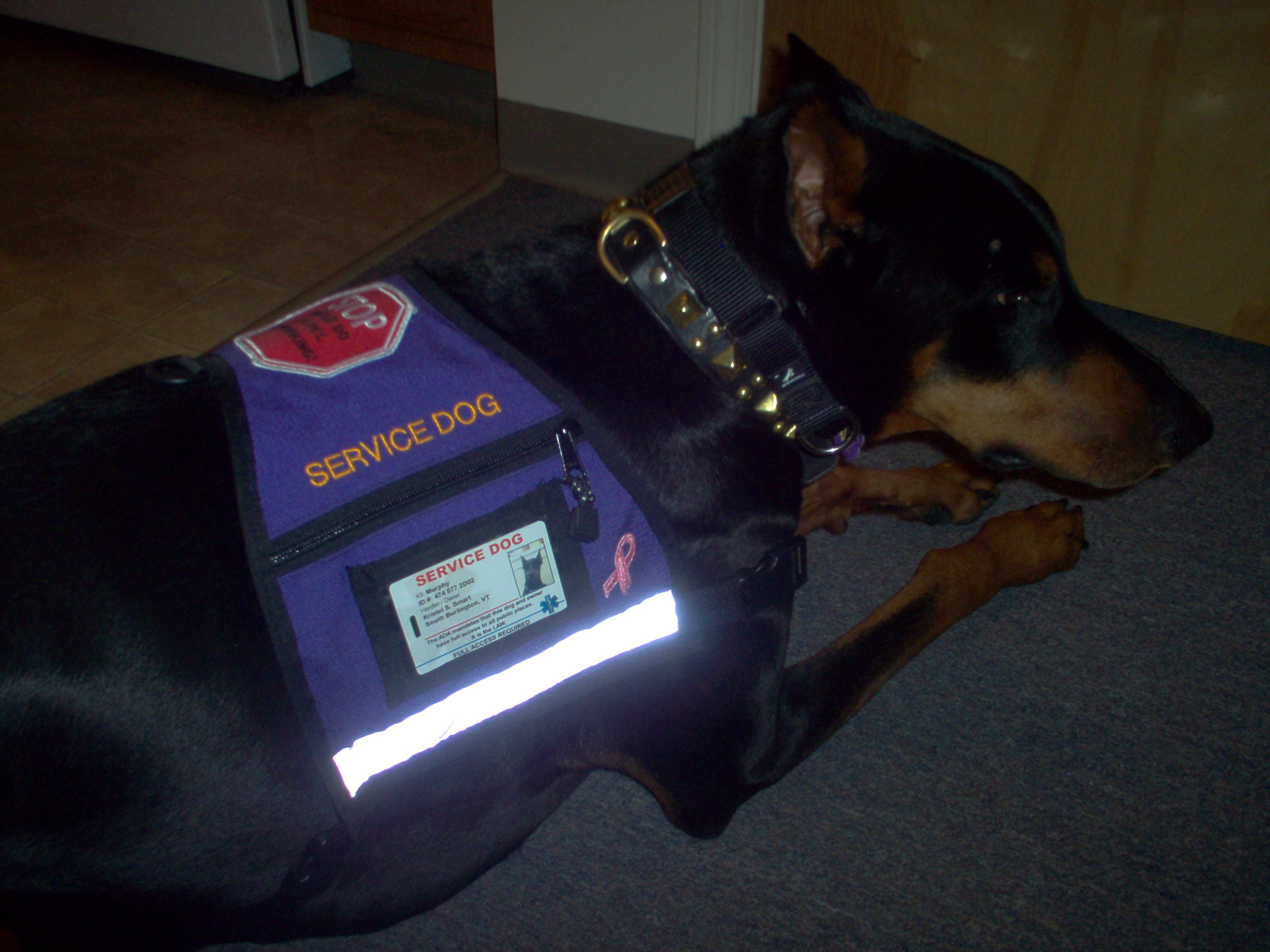
I appreciate your efforts to educate the public, so much. If people would just obey leash laws it would be HUGE. Any dog could be a service dog, just out for a walk; you never know. And it shouldn’t matter. Each of us should have the right to decide how we socialize our dogs and not have that decision made for us. Thank you for calling so much attention to an issue that is not only relevant to many, but life-altering for some of us.” – Kristel S.
Devastating, isn’t it?
Leash laws exist for this reason. If you allow your dog to run loose, in a designated on-leash area, you’re making a choice that could profoundly impact the lives of those around you.
Leash laws are not optional.
If you think it’s oppressive, being required to use a leash: it’s not. If you think you’re the exception to the leash law, because your dog is friendly: you’re not. This is bigger than you and your dog.
People who depend on their Service Dogs for their lives should not be harassed, chased, intruded upon, or attacked because other people believe that the rules don’t apply to them or because they’re too ignorant or irresponsible to control themselves or their dogs.
All of us, whether we have service dogs or not, deserve to live in a safe, respectful environment. We can create that type of community by thinking about the consequences – unintended or not – of our actions and commit to not making poor choices or assumptions that could cost a dog or person their entire quality of life.
Want to learn more about Service Dog Etiquette? Visit Please Don’t Pet Me
Do you have a DINOS (Dog in Need of Space)™ ? Join us on Facebook!
If you’d like to read more from Kristel, please check out her new blog: The Lighter Side of Darkness
Be responsible, respectful, and ask first!
Dec 23

Image by the talented Melody McFarland of Melody Pet Photography
Wishing all of you the happiest of holidays and a new year filled with joy (and stress-free dog walks)!
May all your DINOS dreams come true in 2012!
Dec 20
There are definitely days when I wish I could walk my DINOS is a tinted, protective dome. Off leash dogs would just bounce off our shield and we could go on our merry way!
Turns out, my new pal La Trenda of Stubbypuddin feels the same way. She drew this awesome dog walking dome with DINOS in mind. Thanks for sharing La Trenda and Puddin (that’s her adorable stubby dog) – maybe our domes will pass on the sidewalk some day!

(p.s. if this is the second time you’ve received this post in your mailbox today, my apologies. I had a little techno-hiccup today and had to delete, then re-post this)
Dec 16
Meeting a ROAR (Rover on a Retractable), can be a nightmare for other people walking their dogs, especially DINOS. ROARs are often 10-15 feet away from their owners and this makes it difficult for us to step aside and let them pass without our dogs interacting.
From a distance it’s super hard to determine if the incoming dog is on a retractable or off-leash all together. I’m not a big fan.

My own personal experience with retractables varies from just fine to pretty awful. I walk some small dogs on retractables and I have no problem keeping my tiny DINOS close, I lock the leash when we pass others and I let them roam when we’re alone. I do my best to use the leash correctly and follow common sense dog walking etiquette, the same as I would with a flat leash.
But, I’ve also had really bad experiences with them. I’ve burned my hand trying to grab at the leash when the braking mechanism failed. And worse, my fear reactive DINOS, Boogie, was attacked by a ROAR.
Picture this: there we were strolling on the sidewalk, when a very large dog, standing in his driveway on a retractable, began to chase us. The weight of the dog running at full speed snapped the bulky handle right out of his surprised owner’s hand. The dog ran towards us, bulky handle scraping on the sidewalk, making a terrible noise. He jumped on top of Boogie, biting him on the head. Boogie didn’t fight back, but he did curse at the other dog pretty loudly. The man who owned the large dog was afraid to step in and help me because he had another dog, also on a retractable, and didn’t want to drag that dog into the chaos. It took a third person to step in and get the dog off of Boogie.
Would this have happened if the dog had been on a flat leash? Maybe, but I honestly doubt it. It was the force of the big dog hitting the end of the line at a full sprint that snapped the huge plastic handle out of his owner’s hands. It was the crazy sound of the handle crashing behind him that amped the dogs up even more. It was the lack of a flat leash to step on, to safely pull his dog away, that kept the tussle going because there was nothing to grab onto (the giant handle was left dangling a foot or so off the attacking dog’s neck).
In addition to the control issues, the problem is that, no matter how skilled you are at using them the equipment is known to fail. I’ve worked in pet stores and seen them returned, over and over again, for snapping. I’ve had the breaking mechanism fail on me. And that’s why Consumer Reports wrote that delightful article on finger amputations.
But these leashes aren’t going anywhere, so in the interest of exploring the more (and less) responsible methods of using retractables, I’ve compiled a DO and DON’T list (available as a pdf, minus this whole intro, for easy printing).
A Guide for ROARs (Rovers on a Retractable):
DO: Be aware that retractable leashes have a reputation for breaking, snapping, and otherwise failing.
DON’T: Let your dog’s retractable get tangled around another dog’s body. The friction from the moving tape or string can cause serious injuries.
DO: Lock your leash to 6 feet or less while walking your dog in public around other dogs and/or people (not all people want to be approached by your dog).
DO: Use them in unpopulated areas, such as the woods or your own back yard.
DON’T: Use them with a gentle leader or other training tools. The point of those tools are generally to teach your dog not to pull, to engage with you, or for better control. It’s a confusing message to a dog to be on both a retractable and a head harness or corrective collar at the same time.
DO: Purchase the best quality retractable you can afford. Typically the tape ones are stronger than the string ones.
DON’T: Expect to teach your dog to stop pulling while using these. Your dog is enjoying pulling ahead and wandering off.
DO: Work on your dog’s recall at other times, so that you’re not just relying on the leash to gather your dog back.
DO: Be aware that those bulky handles are difficult to hold on to if your dog hits the end of the line at full speed.
DON’T: Let your dog wander off while in public places like the pet store or at the vet’s office. If your dog can walk away from you, into another aisle or across a room, the point of using a leash (for management) has been defeated.
DO: Consider them a potentially useful tool for environmentally fearful dogs, dogs that are semi-feral with humans, or other dogs that may need some extra space while they are building confidence.
DON’T: Drop the leash, especially if you’re working with a fearful dog. The bulky handle “chases” behind them, making a terrible scraping sound on pavement, further terrifying the dog.
DO: Be aware that Consumer Reports notes that people have suffered serious injuries, including finger amputations and bad burns from retractable leashes.
DON’T: Walk your large reactive dogs on retractables in any place you may encounter their triggers. It only takes a second to miss the opportunity to lock the leash and then you’ve got a thrashing dog, fifteen feet ahead of you.
Printable PDF is here: A Guide for ROARs
Dec 14
Living with DINOS isn't always easy, but you're not alone and there is help! Check out the tools, classes, and techniques that have made a difference for the DINOS community...
Dec 7
Ah, life with DINOS! It’s filled with quirks, isn’t it? If you live with DINOS you’re actually part of a super cool group of humans. I like to call them Team DINOS. We’re willing to do all kinds of oddball stuff in order to enjoy safe, happy dog walks. Are you part of the team?
Your dog walking equipment consists of a leash, poop bags, high value treats, a cell phone, and…a head lamp, so you can walk your dog before the sun comes up.
You’ve caught yourself browsing for Direct Stop on your lunch break.
You drive your entire dog walking route, to search for any trouble spots, before going for a walk.
The unexpected sound of keys jingling makes your stomach do a back flip.
You know what a Happy Muzzle is and think they’re super cute.
Blind corners are scarier than a Hitchcock movie.
You’ve considered adding “excellent horizon scanner” to the skills section of your resume.
You’ve stood around, pretending to admire someone’s mailbox, while trying to keep enough distance between you and the slow moving dog ahead.
You’re considering teaching your Great Dane how to use the toilet.
If you win the lottery, you’re buying a private dog park.
You’ve criss-crossed the same block more than three times to avoid other dogs.
You have a pr eference for the kinds of cars you like to hide behind.
Your hamster’s exercise ball is starting to look like a good idea for your dog, if only you could build one large enough for your Lab.
You know where all the fenced-in baseball fields, tennis courts, and other non-dog park spots are located. And you go there at 10 o’clock at night.
Your neighbor hasn’t looked you in the eye since “that time” you told her where she could stick her roaming off leash dog.
You day dream about what kind of privacy fence you’re going to install.
You’re excited to walk dogs in the rain or snow, since bad weather means fewer dogs to bump into.
You’ve whispered “be very, very quiet” to your dog, as you tip-toed past a sleeping dog in a yard.
You’re not afraid to jump a fence, squeeze behind a dumpster, or cut through someone’s back yard to avoid an oncoming dog.

You think Plastic Man and Inspector Gadget were on to something with those extra long arms. Perfect for catching off leash dogs at a distance!
You bought equipment for a home gym, but you already have a gym membership. The treadmill is for the dog.
On your walks, you wear poop bags on your hands, like mittens, so you can scoop and run.
You’ve got your trainer, your vet, and animal control on speed dial.
What else? Share the quirky stuff you do with your DINOS in the comments section!
Want to spread the DINOS message? Check out these pdfs of your favorite blog posts!
Dec 4
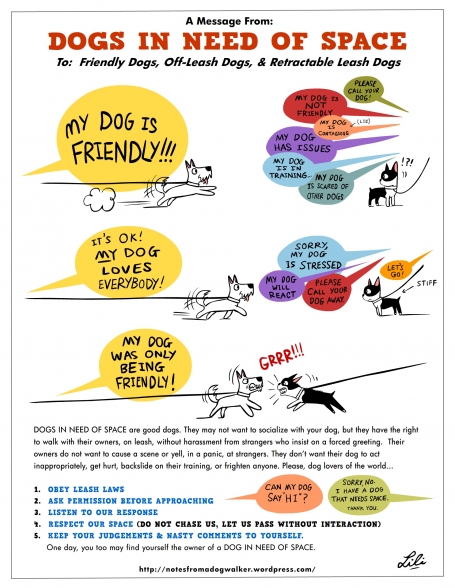
Feel free to share with credit to http://www.doggiedrawings.net
Wow, what a week this has been! Thank you to everyone who has turned one dog walker’s lament into an internet sensation. The DINOS™ concept has taken off and in the past few days, I’ve had requests from all over the world to share the blog in newsletters, public spaces, and adoption packets. The message is spreading, folks. How cool, is that?
And if that wasn’t exciting enough, I was thrilled to discover that Lili Chin, illustrator and mom to a DINOS named Boogie (just like my dog Boogie – what are the odds?), created this fabulous illustrated version of our message! You can see the original post on her blog here.
Many of you have contacted me to see if there are t-shirts and other merchandise available for purchase. I’ve teamed up with a graphic designer (she’ll be revealed soon), who shares her life with DINOS and has agreed to help me turn my slogans, both funny and serious, into gear for a DINOS Cafe Press store. In the not-so-distant future, you’ll be able to warn MDIFs in style!
I’ve also had requests for some sort of unique and clear DINOS symbol for our dogs to wear, in the hopes that MDIFs will be able to recognize DINOS and give them space. I heard your demands and it’s in the works. Details will come later, when it’s more clearly mapped out, but let’s just say it involves the color red and after the holidays I’ll plan for an International DINOS Day to launch it. Stay tuned…
Finally, thank you to all of the dog trainers, dog clubs, rescues, and DINOS families that have shared the blog and joined us on Facebook. There is a movement building that is larger than anything I could have imagined and the potential to educate the public is here.
So, keep an eye here on the blog and on the Facebook page for updates, plus resources and tips for Living with DINOS…We’re Taking Back Our Space!
Viva los DINOS!
p.s. don’t forget to check out Lili’s work at Doggie Drawings!
DINOS © Copyright Jessica Dolce 2011
DINOS Dogs In Need of Space© Copyright Jessica Dolce 2011





 notes from a dog walker