Skip to content

Posts tagged ‘DINOS’

Meet the Kuzzle

Boogie isn’t a huge fan of going to the vet (we’ll save that story for another day). In order to make vet visits a little less stressful for everyone, I’ve been working on getting Boogie more comfortable wearing a muzzle, just in case he needs it. And while he already tolerates wearing his basket muzzle, I’d like for him to have a more positive association with it.

A few months ago I read about “muzzle-cicles” in Grisha Stewart’s BAT book (she has all kinds of great muzzle related advice – check it out) where she describes filling a basket muzzle with food, freezing it, and using it like a Kong.

I figured Boogie would enjoy sticking his snout into the basket to enjoy some crazy-good snacks and doing so just might help him fall in lust with his muzzle, bearer of frozen delights.

I thought I’d give that a try. Here’s how:

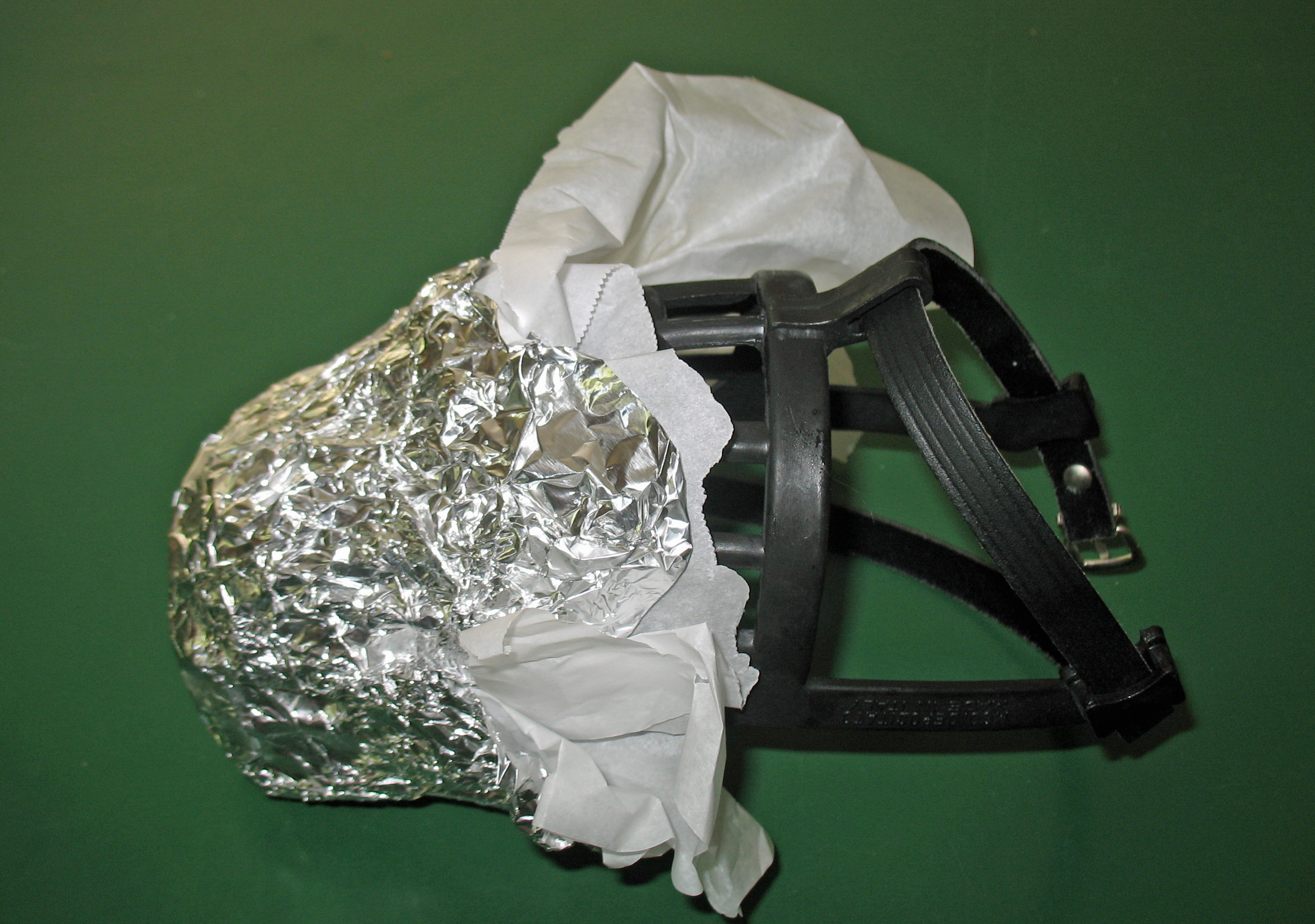
First, wrap the outside of the muzzle in plastic wrap to form a barrier, so the food doesn’t fall out of the sides. I was out of plastic wrap, so I used a piece of wax paper, then covered that in tin foil so I could smush it on there real good (highly technical, no?):

Then I filled it with apple slices at the bottom and a mixture of kibble and wet food. To guild the lily, I spread some peanut butter at the opening. And freeze!

Behold the Kuzzle. 

Or maybe it’s a Mong?  Either way, you’ve got yourself a frozen Muzzle/Kong type treat:

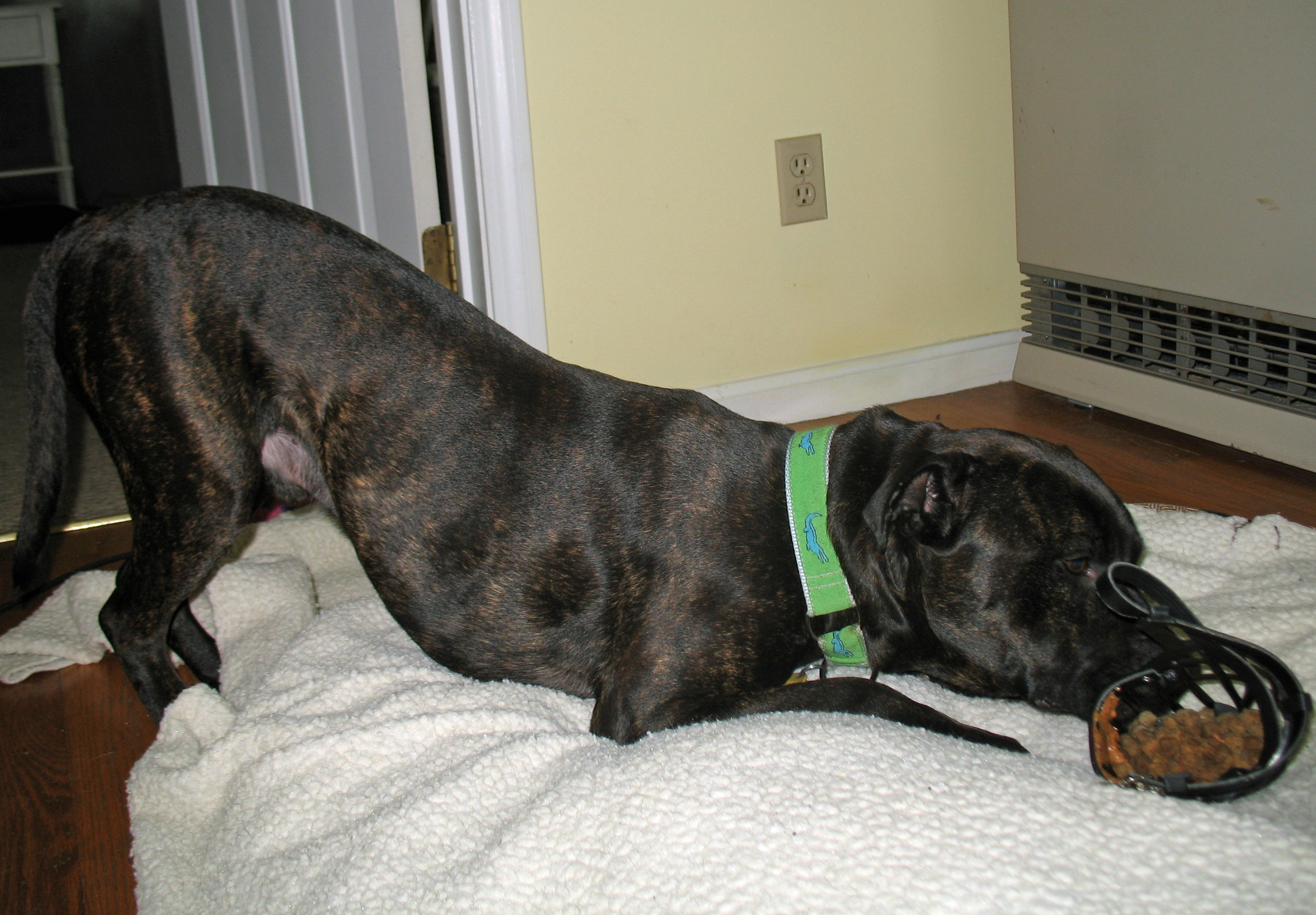
Boogie was wary of it at first, as he is with all novel objects. He licked the outside of the Kuzzle for a while, keeping his tush in the air, just in case he needed to make a quick escape from this odd duck.

Eventually, he settled down on his bed and enjoyed the Kuzzle in all its glory. After lying down and licking away, he stood back up to get some traction so he could score the last bits of food.

He ate it all, then tried to eat the Kuzzle itself.  So my advice is to carefully watch your dogs if you do give this a try. It’s a quick jump from frozen treat to new rubber chew toy.

I’m not sure if this will pay off in the long run, but I’m going to give it a try a few more times in the hopes that Boogie will get all wiggly at the sight of his new favorite treat dispenser.

By the way, Boogie is camera shy, so taking photos of him didn’t exactly help him feel comfortable. Next time, he’ll get to romance the Kuz in private – no paparazzi.

Update: Boogie loves his basket muzzle and wears it happily these days. Huzzah for the Kuzzle!


What about you guys? Anyone do some creative Kuzzling or muzzle tricks at their house?

Looking for muzzles, the BAT book, and more? Check out the Resources on the Dogs In Need of Space website!

kuzzle (1)

The Never Ending Rainy Day

It’s been raining for, like, a hundred years straight here in Maine (ok, ok two weeks) and I. am. going. crazy.

Between playing ball with Boogie in our mud pit of a back yard, coaxing Birdie to please, pretty please, stop pretending she’s a camel and go to the bathroom already, and all the soggy dog walks I’ve been doing every afternoon, I’ve lost my mind.

And I’ve decided this is my future:

patio park

That’s right. I want a Patio Park.

Not only do I want one, but my rain-induced insanity is making me think that buying a van, throwing one of these inside, and offering up a mobile, door-to-door, covered potty break station is exactly what the pet industry needs and I’m the gal to do it.

Right?!

I know that’s bonkers. But I kinda wish I could do that today, this millionth day of rain.

p.s. This actually might be handy for city-DINOS. Or is that the soggy mush in my head talking?

Be Polite. It Could Save an Epileptic Dog’s Life.

DINOS touches on all kinds of issues, but mostly it’s all about this idea: Some dogs need space, so it would be awesome if everyone had control of their dogs, obeyed leash laws, and always asked permission before allowing themselves or their dogs to approach unfamiliar dogs.

That not-so-complicated idea can be boiled down even further to this really, really simple idea: Please be polite, respectful, and responsible.

I heart boundaries tee

Got Boundaries?

Regardless of why a dog may need space (there are so many reasons: health, medical, occupational, and behavioral) the only thing most of us want is the opportunity – the right – to choose whether or not our dogs will interact with other dogs or people.

We’re reasonable about this. We’re upholding our end of the bargain by responsibly managing our dogs and getting out of the way. We know we can’t always control our surroundings and we don’t expect others to go out of their way to avoid us. But it stinks when our ability to choose what’s best for our dogs is taken from us. That happens when someone is breaking the leash law or can’t/won’t control their dogs (on leash or off).

For many of us there are serious consequences when our ability to choose who our dogs interact with is taken away from us.

I recently heard from a reader named Mary:

“I just wanted to thank you for making people aware of this. My dog has epilepsy and while people’s ‘dogs are friendly’ they can kill my dog.

Certain scents cause him to go into cluster seizures that take a dosage of Valium to wake him up. Just smelling the medication put on the back of a dog’s neck used for heart worm/fleas can cause a horrible reaction.

I’m sick of having to run away or protect my 100lb dog from these very hyperactive dogs. If we wanted to encounter off leash dogs, we would simply go to a park. It’s so very frustrating…If people would just ask before approaching and not unleash their dogs to meet us, I would be so happy. It seems so simple right? We all deserve respect.”

Please help me stay healthy. Ask permission before approaching.

This blew me away.  Taz is a DINOS because he has epilepsy and he needs space to stay healthy. You would never be able to tell, just by looking at him. But you can help keep him safe just by being polite.

The thing is, Mary purposely walks Taz in areas that have leash laws, but still encounters off leash dogs who run up to her dog and can compromise his health. She’s not going to off-leash areas or dog parks. Mary doesn’t want to ruin anyone’s good time with their dogs.

She just wants to be able to walk her teddy bear of a dog in public, without fear that someone else will break the law and let their uncontrolled dog (friendly though they may be) run up to her dog and possibly cause a reaction that could kill him.

She’s not asking for much, but she’d really appreciate it if we were all polite, respectful, and responsible.

We can do that right? We can obey leash laws, control our dogs, and remember to ask permission before we allow ourselves or our dogs to approach an unfamiliar dog, can’t we? We teach children to ask permission before approaching a strange dog. Why can’t adults do the same?

I think we owe it to each other to do so. In this wacky world, a leash and a few polite words go pretty far in keeping us all safe and comfortable in public places. Accidents happen, of course, but we can at least try to be respectful of one another.

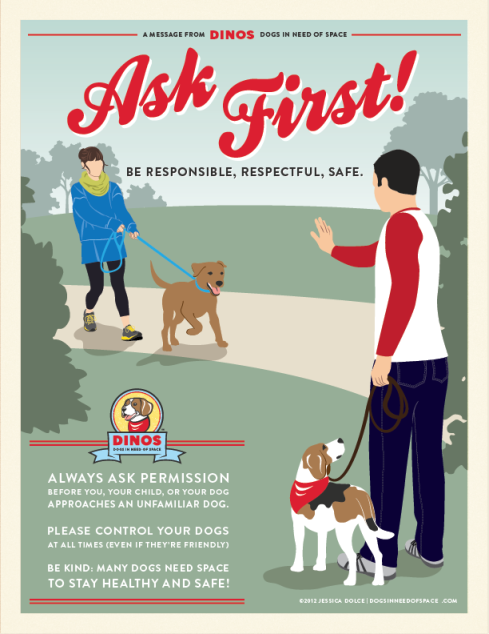
DINOS ASK FIRST poster

Download on Flickr: http://flic.kr/p/dEKWrH

And it’s not just those of us with DINOS that wish dog owners would be more courteous. Senior citizens, children, and people afraid of dogs – they all have a right to use public spaces without fear of being chased or jumped on by dogs that are out of their owner’s control (on leash or off).

But this blog is about dogs, so back to them.

Taz is a reminder that you may not be able to tell just by looking at a dog if they’re epileptic or recently became blind or if that puppy will be a Seeing Eye dog one day. Or maybe they’re just having a tough day and need space for a few minutes.

When we assume that another dog will be ok if we allow our loose dog to chase after them or we let our leashed dog pull us over to say “hi”, we’re making a judgment call without all the facts. And in doing so we are taking away that other person’s right to choose what’s best for their dogs.

It’s impossible to know what’s going on in someone else’s world just by looking at them and their dogs. That’s why we need to remind dog owners to take responsibility for themselves and their actions all the time, around ALL dogs.

Doing so allows all of us to be part of a community that treats everyone – two and four legged – with respect.

It starts with obeying the law, having control over our dogs, and asking, “Can we meet your dog?”, then listening to the response in case the answer is “Sorry, but no.”

Just good old-fashioned manners. A bit of politeness towards a stranger and you could save a dog’s life.


You can help pass along this reminder with the Ask First poster and handout. Trainers, vets, shelters – these resources are free. Please pass them along to your clients and the public!


(2013 Note: Yes, yellow ribbons  are now one way to signal that a dog needs space, but not everyone will understand what it means or be able to see it or stop disregarding leash laws. For long lasting changes, we can focus on educating the public about being respectful and responsible for their actions all the time, around all dogs.)


How to Score a Dog Bite: The Joggers and Bikers Edition

Hi there. You look really fit. All tan and muscle-y and stuff. Oh, it’s because you’re a jogger. You look like a long distance kind of dude. And you’re a cyclist too? Well aren’t you the picture of health.

What was that? I’m sorry, I don’t think I heard you right. Did you just say you really want to get bit by a dog?

You did. Um, you know that’s crazy right? No one likes dog bites. They kinda hurt. Ok, ok. You really want to get bit, huh?

Well, since you asked…

So You Wanna Get Bit By a Dog: The Joggers and Bikers Edition

If you really want to get bit by a dog while you’re jogging:

Scout out a narrow trail, filled with pedestrians and dog walkers. With no audible warning, sprint up behind a dog, passing it so closely that your personal gust o’ running wind parts their fur.

The surprised dog, startled by a total stranger rushing them from behind, will likely be one of the following: scared, threatened, excited, or spun around and confused.

You’ve increased your chances of getting bit. Well done. If you aren’t too busy bleeding, don’t forget to check over your shoulder. You may not have scored that dog bite you’re bent on getting, but you’ll get a good chuckle at the dog walker who is now struggling to calm her startled dog. Score!

Did you see me scare the crap out of that dog? High five bro!

Not into doing it from behind? Try sprinting at a strange dog head on! When you spy a dog strolling on leash, pick up your pace and run right at the dog. Most dogs will think you’re coming to hurt them, hurt their human, or play with them.

Either way, you’ve got their attention now! Bravo. Look forward to lunging and barking. Fingers crossed for that dog bite you’re obsessed with getting.

Like riding bikes? Why not do it on a crowded sidewalk or walking trail, filled with pedestrians and dogs? There’s nothing that screams, “I want a dog bite!” like speeding past a dog who has no room to escape you and your hot wheels.

For extra points, scream at the dog walker for not getting out of your way. What do they think they’re doing walking on that sidewalk? They should stay out in the road with the cars….where it’s safe!

Obviously, I’m kidding here. Don’t ever do this stuff. Stop it right now.

For real: Can we talk about how crazy it can be negotiating bikes and joggers with our dogs?

They way they charge at our dogs is like some special brand of stupid. They’re just begging for a dog bite.

And I happen to know that they can’t stand us either. I love checking the search terms that people plug in to find my blog. I’ve gotten a bunch of search terms that go something like this: ‘”I hate dogs while I’m jogging” and “I want to run over dog walkers with my bike and then back up and do it again, while ringing my dumb bell.”

Ok, not the second one so much, but I do see the first one a lot – joggers don’t like dealing with our dogs any more than we like dealing with joggers.

If we’re both miserable, why can’t we call it a truce and end this perpetual Fight Club we’re in with each other?

Here’s what I propose:

Joggers: if you see a dog, go wide. Do not run directly into, up to, or past a strange dog. Exit the sidewalk and run in the street. For like 10 feet. Then you can get back on. No biggie. If you’re trapped on the path, slow down and walk. I can hear you guys now: “Walk?! I’m a runner!” Fine.

At the very least, say something clear and understandable from a distance, like “INCOMING JOGGER BOMB ON YOUR LEFT!” or whatever you think will be the best way to alert a dog walker that you are coming up from behind and they need to move over. Please don’t heavy breathe a polite, quiet, “excuse me”, at the exact same time you’re passing us. That doesn’t give us enough time to react. I’m usually thinking about my next snack while I’m dog walking. Please give me enough time to snap out of my cupcake cloud and move over.

That’s all we want, really. The chance to move out of your way. Cuz we like our space.

And if you run with your dog, keep them close to you. Don’t let them run right up to, squeeze by, or surprise strange dogs.

Bikers: Get off the sidewalks. Period. Unless you’re in elementary school, it’s time to suck it up and ride in the streets. It’s just not fair that pedestrians have to contend with bikers on sidewalks. Especially on crowded city streets. This actually has nothing to do with dogs. I’m saying this for all of us: dog walkers, senior citizens, children, people who dislike being run over.

If you think it’s too dangerous to ride in the streets (I feel you on this, by the way – I was terrified to ride my bike in the city), take the subway. And don’t you dare give me lip if I’m in your way and don’t move over fast enough. These aren’t called bikewalks.

The City of Evanston gets it. Those people look really happy.

Dog walkers: We need to behave too. Don’t let your dogs lunge at or jump on joggers and bikers, if you can help it (meaning – you weren’t caught completely off guard). If they’re giving you space, be thankful and control your dogs. Keep your dogs on leash. Retract your flexi leads.  At home, contain your dogs in your yards by fence or lead, so that they can’t chase people.  Get off the phone and take off the headphones, so you can hear what’s going on around you. Be good, responsible dog owners.

That’s not so bad, is it?

No one wants to get bit. No one wants their dogs to bite someone. Instead of creating the prefect storm for a dog bite: charging and startling an unfamiliar dog, let’s work together to set dogs and humans who like to sweat in public up for success. We can do it – this whole being polite and giving each other space thing – I just know it.

(p.s. I know you guys know this already, but don’t be silly about what you read here. That stuff in the beginning was a joke. You will not hold the author of this blog responsible for any incidents related to the materials published here. www.notesfromadogwalker.com assumes no liability or responsibility for your actions.)

The Flirt Pole: Dog Toy or Life Changer?

I’m headed out for a week of pet sitting in a neighborhood that’s overflowing with loose, sometimes aggressive dogs. I’m not worried. Here’s what I’m packing:

Why the flirt poles? Because in addition to driving out of the neighborhood to walk in a safer area, I also want a fun way to exercise the dogs I’m caring for…without having to leave their fenced in yard. Sometimes walks just aren’t all they’re cracked up to be. I know you feel me on this.

Guys, I want you to meet your new BFF. Introducing the The Flirt Pole:


flirt pole


The flirt pole is what you’ve all been waiting for. It’s a an easy DIY toy (that you can also buy for under $30 bucks, if you hate making stuff). It not only helps your dog work on their basic manners and impulse control, but it also gives them a rockin’ workout in just a few minutes.

And you hardly have to do a thing.

This is a great way to physically and mentally challenge your dogs, without leaving home.

Wanna know more about this magic pole?

Let’s do this in lists…ready?


How a Flirt Pole Works:

You drag the toy on the ground in a circle, they chase and tug, with rules.

Think Giant Cat Toy.


Why you want to use a Flirt Pole:

1. It totally and completely exhausts dogs in record time. But it doesn’t exhaust you.

2. You can use it as a fun way to practice the following commands: sit, down, look, wait, take it, leave it, drop it.

3. You’ll be working your dog’s rile/recovery skills. That means they’ll get to practice listening to you when they’re in a state of high arousal (chasing and tugging) and learn to cool off quick (drop it and lie down) when you say so. Handy for reactive dogs who are working on impulse control.

4. You can tire out your dog at home, before going on a walk, so they’re more relaxed.

5. You can tire out your dog at home, instead of going on a walk, so you’re more relaxed.

6. You can make a small flirt pole (half the regular size) and use it inside the house, if you don’t have a yard.

7. You can trick your cats into thinking they’ve shrunk, by telling them it’s their regular chase-it toy.


How to make a Flirt Pole:

1. For a medium to large size dog, buy a 4-6 foot long 3/4″ PVC pipe, 10-15 feet of rope, and a dog toy.

2. Thread the rope through the pipe and tie a knot at either end of the pipe, to keep rope from sliding in and out.

3. Tie a toy to the end of the rope.

4. Optional: buy fun colored electrical tape (finally an excuse to buy lime green tape!) and wrap the pvc pipe so it’s all fancy schmancy pants.


flirt pole meme


Where to Buy a Flirt Pole, if DIY isn’t your thing:

1. Outward Hound makes a lightweight one (a good option for smaller dogs or smaller yards):

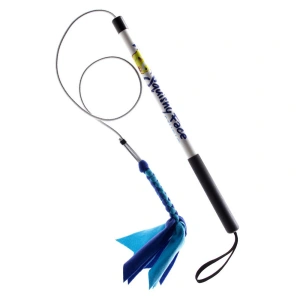
2. Squishy Face Studio makes an awesome flirt pole:

flirt_pole_4__82304.1394318267.1280.1280


Flirt Pole Rules You Will Use:

1. Dog must lie down, look at you, leave the toy alone, and wait for you to release them, before playing.

2. When you tell them to “take it”, then they get to chase.

3. After a few passbys, reward them by allowing them to catch the toy.

4. Let them tug until you tell them to “drop it”.

5. Have them lie back down and wait until they are calm. Then start again.

6. Change direction every once in a while, so your dog isn’t always running one way.

7. If the dog grabs the toy before you say “take it” or is mouthy or jumping on you: take a time out and/or start over.


When to skip the Flirt Pole:

1. If your dog has bad joints or injuries that could be aggravated by quick changes of direction and jumping.

2. If your dog doesn’t know the following cues: wait, take it, leave it, drop it. Practice with treats first, then a tug toy, then move on to the flirt pole.

3. If you do not know the dog well. It’s not safe to rev up an unfamilar dog. While this is one of my all time fave tools for shelter dogs (it tires them out so fast!), they must know basic commands and you need to have a relationship with the dog, before getting them super psyched. Establish a working bond first – make sure you’re communicating with each other – then start off slow.

4. If this overstimulates your dog to the point that they can’t calm down after. You know your dogs. If this isn’t a good fit for them, just pass.

5. If your dog thinks it’s dumb. Some dogs just don’t dig it.


Everything I know about flirt poles, I learned from Pit Ed Camp hosted by the badasses at BAD RAP. If you learned something here, it’s because of them, so feel free to click on over there and donate some scrills to support their work.

In fact, here’s Tim from BAD RAP showing you exactly how to boogie down with the flirt pole:

Training Video: Flirt Pole Basics from BADRAP.org on Vimeo.


Are you using a flirt pole at home? Tell me about it!


Talking TACT

I just got back from a great weekend at the New England Federation of Humane Societies Conference where I had the chance to spend a couple of days learning about better ways to support the pets and people in our communities. As a bonus, I also got to attend a TACT seminar!

TACT, which stands for Touch Associated Clicker Training, is a behavior modification program for fearful dogs. Created by Julie Robitaille and Emma Parsons (author of Click to Calm, Healing the Aggressive Dog), TACT is, in their words:

TACT, Touch Associated Clicker Training creatively combines the science and art of learning theory, clicker training and massage therapy. This unique approach is used specifically to rehabilitate and prevent shy, fearful, reactive, and aggressive behavior in dogs and puppies utilizing positive training methods.

TACT utilizes a ritualized protocol designed with safety, structure and predictability.  TACT develops confidence and coping skills while changing the emotional response in fearful dogs.  TACT incorporates a detailed home management and real world exposure control program for owners to follow to coincide with their training protocol.

The seminar was geared towards working with dogs that are very fearful around humans (not other dogs). My understanding is that this program has been formulated for dogs that are specifically reactive to people.

Julie kicked things off with an introduction to TACT and how she incorporates ritualized protocols that are safe, structured, and super predictable. In each of the four learning stages, the individual dog’s triggers are broken down into the tiniest parts and the dogs are carefully and slowly exposed to their triggers. Through the counter conditioning process, TACT works to desensitize dogs to their fear of people, ultimately changing their emotional response.

Julie showed us some videos of her clients, that I wish I could show you. The early sessions began in an enclosed room with just the handler, the dog, and Julie. Each time they met, throughout each stage of progress, the same protocols and routines were utilized in order create and maintain predictable patterns.

So, the very simplified version of this might be: if a dog is reactive towards large men walking at 15 feet away, TACT starts with a small woman sitting in a chair at 20 feet away.  The work begins with the dog behind a visual barrier and just listening to the strange woman’s voice. Then, for example, the dog is brought out to see the woman and as long as the dog is calm and comfortable, the next step might be the woman turning her head to look at the dog, then turning away. It’s Baby Step Central.

The dogs are rewarded throughout this process by clicking and treating whenever they offer up certain foundation behaviors, such as looking at the person (similar to LAT), checking out novel items,  or eventually allowing brief touch.

Julie shared that through her work as a massage therapist she realized predictable patterns, more than anything else, reduced fear in the dogs she was working with. That realization was a game changing moment for her. So TACT is intentionally very ritualized and predictable. The predictability the dogs encounter through TACT, coupled with a positive outcome each time, helps calm the dogs and shapes their emotional response from fear to calm and confident around unfamiliar people they encounter.

There are many terrific counter conditioning protocols out there, but what makes TACT particularly unique is the addition of therapeutic touch. Julie shared a quote at the beginning of her talk: “When I first began my massage therapy practice I knew I would be massaging the body, the mind and spirit but I had no idea I would be massaging behavior.” Her work as a massage therapist helped her to discover that therapeutic touch was changing her client’s behavior even after the massage work was over. So she incorporated this into TACT’s training methodology.

As Julie pointed out, touch is subjective, so we have to let our dogs choose if they want to be touched. In TACT the dogs are eventually touched by Julie, through slow, measured steps and, if the dogs actively seek out more touch, she moves on to therapeutic body work.

Dogs are gradually exposed to new people and environments, so they can begin to generalize what they’ve learned. But in each stage, the ritualized protocol work is repeated (the dog moves through it faster), so that they know what to expect.

The method itself isn’t complicated, but Julie made it clear that TACT takes time, effort, commitment, and hard work. She very wisely reminded the group that the work isn’t determined by what you want – it’s shaped by what the dog needs and that often means we have to slow way down, taking small steps that will add up to success over time.

Oh and there’s still NO CURE.

No matter how much progress you make, there’s no “cure” for reactivity or aggression. Julie pointed out that there are two crucial comments to TACT: Management and Training. In order for TACT to be successful (or any other program, in my opinion) you need to always be doing both.

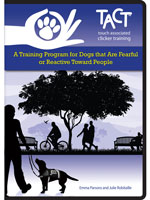
You can go to her website to learn more about the specifics of TACT (since I’m not a trainer, I’m not fluent in training-ese and she can tell you more than I can).  You can also order her DVD and workbook package from Clean Run, so you can learn the steps in detail. From what I understand Julie and Emma are the only two certified TACT professionals (though a TACT certification program is coming soon) and they’re both in Massachusetts, so if you’re in their area, it might be worth doing private sessions with them.

tact_dvd

After listing to the presentation, I’d say that TACT could be of real help for some of your dogs, especially if you have the time and are committed to doing the work. It’s not a quick fix and you must have people who you trust to help you with the ritualized work.

I’m not exactly sure how I would implement this in the hustle and bustle of a shelter environment, but this would be a great program for anyone fostering a fearful dog. As for my own DINOS, Boogie, he’s more reactive with dogs than people (strangers scare him, but only briefly and he’s gotten much better over the years), so I’m not planning on trying TACT at home. But if your dog is aggressive or reactive towards humans, this is worth checking out.

Whether or not TACT is right for your dogs, Julie did have some good management ideas and tips that all of your dogs can benefit from:

Create a Safe Space in your house. Visitors to the house can be a really stressful (potentially dangerous) time for your dogs, so create a safe space in your home for your dog. Ideally this would be a separate room with a door you can close. When guests come over, have your dog go to their safe space BEFORE your guests arrive (not when the doorbell rings). Turn on soft music or a white noise machine and let them relax in their safe place.

To get them ready for this new routine, teach your dog to go their safe space and get comfortable. Have them stay in the their new safe space for up to 20 minutes before you release them. Practice this often, so that when your guests do visit, your dog is already comfortable with this set up.

Home should be Fun! Our dogs are often stressed and uncomfortable out in the real world. Make your home a safe, fun environment for your dogs by taking a look at their environment. If they’re sound sensitive, invest in a white noise machine to block out the sounds. If they’re visually overstimulated, cover windows that they perch near. Most importantly, spend time on enrichment that stimulates them mentally, so they can drain down their batteries, through puzzles, interactive toys, etc.

Real World Management Since people are everywhere (don’t we know it!), management will always play a big role in living with a fearful or reactive dog. Julie recommends:

Always use a leash, even if your dog has an awesome recalltraining_vest_sm

Desensitize your dog to a muzzle, so if they ever need it, they’re comfortable wearing one.

Practice the “Let’s Go” command, so you can make quick getaways

Drive around to look for less crowded public places to walk your dogs

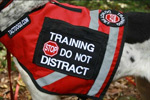
Have your dog wear a vest that tells people they are training.

What I really appreciated about the seminar is that Julie recognizes the incredible emotional toll that living with a reactive dog can have on their people. It’s stressful and frustrating and sometimes sad. Julie gets this – she’s been there – and developed the TACT Caregivers Fatigue Program. If you’re feeling burned out or at the end of your rope, I highly recommend you check this out. There are support groups online and if you’re in the Massachusetts area, there’s even an in-person support group, both are run by Anne Lindsay, a professional counselor.

Overall, a really positive seminar and I hope that those of you with dogs that are reactive to people will check it out to see if it might be a good match for your dogs.

Have any of you tried TACT?  What are your thoughts on the program? Let me know!

Boom Chicka Boom Boom

I’ve had the pleasure of spending the last couple of days getting to know the squishest gal at Animal Farm Foundation. We went for a walk together this morning and though she’s still working on her dog-dog skills (she’s a DINOS while she’s in training, but is fast improving), she was a pleasure to go exploring with on a sunny Spring day. And did I mention this monkey is up for adoption?

Meet Chicka Boom!


How can you not fall in love with that face?


She’s ready to spend summer with a family. Scoop this sweet mama up, will you?


Just get in touch with the folks at Animal Farm Foundation (they’re in the Hudson Valley region of NY State) and go meet her:  info@animalfarmfoundation.org

p.s. Anyone going to the New England Federation of Humane Societies conference this weekend? I am! You can catch me on Sunday at the Animal Farm Foundation table and on Monday, where I’ll be listening in on the AFF and Bad Rap seminars. Stop by and give me a Team DINOS Solidarity fist bump, ok?


5 Ways A Carabiner Could Save Your Dog’s Life

Carabiners might be my favorite dog walking tool of all time.  Why? Because no matter what equipment you use to walk your dogs – accidents happen and equipment fails.

I’ve seen dogs slip their shoulders out of Easy Walk Harnesses, whip their heads out of Gentle Leaders, back out of collars, and prong collars pop wide open. And when that happens…your dog is loose. Yikes.

That’s where carabiners come in. If you slap on a ‘biner, that failed equipment will still be attached to something else on the dog’s body (usually a flat collar) and your dog will still attached be to you and the leash. Carabiners are rad little dudes.


Here’s 5 ways to use a carabiner:

Connect the flat/martingale collar to the Easy Walk Harness or other body harness

Connect the flat/martingale collar to the Gentle Leader or other head halter (try a small carabiner, if the regular size is too heavy)

Connect the flat collar to the Martingale Collar

Connect the flat/martingale collar to the prong collar

Connect the leash to your belt loop or wrap the leash around your waist and secure with the ‘biner (it’s an extra layer of protection if you ever drop the leash when your dog decides to break dance at another dog).


To be more specific: Slide the carabiner through the ring on your dog’s flat (or martingale) collar and through the ring on whatever piece of equipment they are wearing, let’s say: the front ring on a body harness. Attach your leash as you normally would to the front of the harness.

Like this:


Now, if the dog gets out of the harness: your leash will still be attached to the harness (now dangling loose), because it’s attached by the carabiner to the flat collar. So your dog will suddenly have an extra few inches of “leash” in that failed harness, but ultimately, you and the leash are still attached to the dog via the carabiner clipped to the flat collar.


Another view (FYI: Boogie’s collar looks loose because he’s wearing a martingale collar – I coulda/shoulda connected the carabiner to the D ring of the martingale and his collar would then be snugger in this scenario):


If a carabiner doesn’t work with your equipment or you don’t have one on hand, at a minimum, you can try clipping your leash to both pieces of equipment. You can even buy a leash with a built-in carabiner from Ruff Wear.

So head over  to a camping store and buy a good one – spend a few bucks – and it will last you forever. I have a lucky carabiner that I’ve been wearing for 14 years. I’ve lent it to people during dog training classes and afterwards, chased them down the street to get it back. I mean business when it comes to my biner.

*Team DINOS fan tip: choose a carabiner that locks (like the one on the Ruff Wear leash) for an added layer of safety. Thanks Rachael M.!

And one more reason to use a carabiner:

You can keep your keys on one and tell people you’re a janitor or prison warden, like I do:

Happy and Safe Dog Walking Everyone!

Hello Off Leash Dogs. Meet My Friend Direct Stop.

(Download and print the pdf version of Hello Off Leash Dogs)

Ask anyone who walks DINOS: “What’s your worst fear?” and they’ll all tell you the same thing: Off Leash Dogs (OLDs).

When you’re out walking your DINOS and you spot a loose dog, with no owner in sight, it’s hard not to throw up, just a little, as you mentally run the list of ninja moves you might need to escape untouched.

With that in mind, I wanted to share some tips for dealing with OLDs. But just so we’re clear, nothing works 100% of the time.

The thing about off leash dog encounters is that they’re a little different every time and there are always a lot of variables in play. So what works once, doesn’t always work the next time. What’s safe to try with one dog, may not be safe with another. I know, because these tips don’t always work for me.

I’d be perfectly happy if someone invented a Pop-up Teflon Dog Walking Tent, so that I could lurch down the block with my DINOS, safely ensconced in our own personal fortress. But hey, sometimes these tips do work, so they’re worth storing in the old noggin.

Here they are, starting from the beginning:

INVEST in a wardrobe that has generous pockets or a little dog walking bag.

On every dog walk, you should take the following, in addition to poop bags:

High Value Treats

Cell Phone with Camera and Animal Control on Speed Dial

Direct Stop aka Spray Shield

+ One Bodyguard (it does help to have a second set of hands, just saying)


BE QUIET

There are a lot of loose dogs hanging out in their yards. The very first thing you can do to avoid a confrontation is to slip by unnoticed. I do this two ways:

Cross to the other side of the street, so I’m not directly in front of their property

 Tell my dogs to put a lid on it aka silence those tags


Tip for Leashed Dogs or Dogs Inside Houses: Being quiet helps, even if the dogs you’re passing are inside or on leash. I used to walk a reactive Olde English Bulldog that wore so many tags, collars, harnesses, gold chains, gongs, and sleigh bells that we alerted every dog in the whole of South Philly that we were coming. Not surprisingly, we had to walk a gauntlet of barking dogs and he struggled mightily to keep his cool. It was unnecessary work – we were bringing the dogs to us, when we really wanted them to go away.


ENGAGE YOUR DOG

Sometimes our DINOS are the ones attracting the attention with all that “debating” they like to do. So if you spot a dog before (or after) your DINOS does, be sure to engage your dog. Keep them focused on you, instead of staring or lunging at the other dog. Ask them to “look” at you. Talk to them in a happy, loose voice. Sing them a silly song with their name in it. Put a treat or toy in front of their nose. Do whatever you need to do to keep their attention on you, as you steer them past the dog hanging out in your neighbor’s yard, or while you do a u-turn (see below).  You can flash a “stop” hand signal at the other dog too, just to reinforce the message that you and your dog aren’t interested – thank you very much.


Tip for Fenced in Dogs: If you’re passing dogs that are contained and barking or running the length of the fence, try this: Cross the street to make space and say “Hi Guys!” in a loud and cheery, high-pitched voice. Sometimes that’s all it takes to shut them up and it tells your dog that things are ok.


LICK YOUR LIPS

You need to try to stay calm, if you want your dog to stay calm too, so do a body scan. Are you pulling the leash tight? Relax a little. Are you holding your breath? Lick your lips. You can’t really hold your breath and lick your lips at the same time. Talk in a happy tone. Let your dog know you’re cool.


WHEN A DOG IS FOLLOWING YOU:

In any situation you have to do two things – deal with your dog and the oncoming one.

This is really hard because these encounters typically happen in a matter of seconds, so even the best laid plans go out the window.

I won’t lie: I full on face-planted a few months ago when a total loser  lovely gal opened her front door, which opened right onto the street, and let her dog run out just as I was passing with a reactive dog. As the door opened, I was already moving to the other side of the street, to make some distance, and called “Get your dog NOW!”, but the dog was sprinting and caught up in a second. I tripped on my dog as I was trying to wrangle her and I fell. It happens. So I held on to the leash, as tight as I could while lying on my stomach, and my dog lost her marbles at the end of the leash. The other dog, stood, just an inch out of my dog’s reach, until the gal finally came to get her dog. I was glad I didn’t let go. I had a skinned knee, but neither dog got hurt and I have no doubt that had they made contact, that wouldn’t have been the case. Just wanted to share that even though my brain was telling me to do this stuff, I couldn’t make it happen that time, so I just wiped out and held tight!


FOR YOUR DOG: EMERGENCY U-TURN

Teach your dog to move quickly and calmly in the opposite direction, so that when you encounter a loose dog or a scary person, you can make a fast getaway. Teach them to do this on cue using a phrase and tone you’re most likely to use if you encounter this scenario.

Like “Uh-Oh! Let’s Go!” or “Holy Shit!” Whatever you think you’d actually say.

Here’s one way to teach them this trick and check out Feisty Fido for more, including Emergency Sit.


IF YOU CAN’T GET AWAY:


FOR YOUR DOG: BODY BLOCK

This means getting in between your dog and the oncoming OLDs. Ideally, you’ve taught your dog a great sit-stay, so that you can step directly in front of them to deal with the loose dog.


FOR THE LOOSE DOG: USE THE VOG

That’s the Voice of God aka what James Earl Jones sounds like.

Step in front of your dog and, using the VOG, say:

NO, SIT, or STOP and flash the universal hand signal for stop: a flat outstretched palm.

The goal here is to startle the crap out of the other dog, so you want to really BOOM! If you’ve got their attention, try telling them to STAY or GO HOME. Be fierce, stand tall, say it like you mean it.


WITH THE VOG OR IF THEY’RE STILL FOLLOWING YOU:


FOR THE LOOSE DOG: HURL TREATS

Take a handful of those high value treats you’ve got in your pocket and throw them right in the other dog’s face. The goal here is to startle them, then have them look around for the food, giving you enough time to get away. I’ve had a 50-50 success rate with this, so it’s worth a try, but I’ll be the first to admit, it doesn’t stop all dogs. Patricia McConnell did a test run you can watch here.


Or Toss Pea Gravel at their feet. If you’ve got room in your cargo pants for a hand full of pea gravel, it can be worth carrying some to startle oncoming dogs by throwing this at their feet.


Tip for On-Leash Dogs: Occasionally, I let a few treats slip out of my hand when someone is rapidly walking up behind me and my DINOS and I can’t get away or make space. I’ll just drop a few treats on the sly, so the dog coming up from behind takes a second to sniff around for the food, and I’ve got an extra minute to make some distance.


WHEN YOU ARE TRAPPED:


USE TOOLS

If your voice and treats don’t work and you can’t get away (and really, you only have a few seconds to make these calls, so you can just skip to this step, if you need to), this is when it’s handy to have another tool on you. If you frequently walk in a neighborhood plagued with off leash dogs that you anticipate fending off, it’s worth carrying one of the following:

Direct Stop

Umbrella (pop-up)

Airhorn

Shake can

Walking Stick

The idea would be to body block your dog, by standing in front of them, and then use any of the tools you have to stop the oncoming dog. Spray ‘em, pop the umbrella open in their face, throw the penny can at them, blast the air horn, block them with the stick.

I vote for Direct Stop, a citronella spray. It won’t harm the dog, if you have to spray them, so you’re not risking their health. Plus, if their owner is nearby, just the sight of the spray will likely get them motivated to grab their dog, since they don’t know it’s harmless. If you use it, spray the dog right in the muzzle.

I highly recommend practicing with these tools. I’ve heard from dog walkers who have had Direct Stop on them, but in the chaos of the interaction, their brains totally bailed and they couldn’t remember how to use the spray. To build confidence and a higher chance of success, practice unholstering and spraying. By repeating the movements when you’re at ease, you’ll build a muscle memory for that action, so that when panic takes over your brain your body will still remember what to do.


WHEN ALL ELSE FAILS:

Here’s what some people I know have done, to get their dogs away from OLDs:

Thrown them over a fence

Thrown them over their shoulders while kneeing/kicking the loose dog

Thrown them into the bed of random a pick-up truck

I’m just saying, it’s been done.

If the two dogs actually do connect, expect a lot of noise. Dogs sounds awful when they’re in a tussle, but it’s usually far worse sounding then it actually is. Try to stay calm (so hard), but if you’re alone, I do suggest calling for help. I’ve yelled loud enough to get neighbors to come out of houses and give me a hand. Having a second set of hands is worth screaming for.

If you have a helper, break up the fight by: making a loud noise, spraying the dog with your Direct Stop, or finding something to use as a physical barrier to smash/slide in between the dogs so that you can safely separate the dogs. Look for something big, like a trash can lid, a chair, a recycling bucket, anything large and nearby that you can wedge between the dogs. Grabbing collars is an invitation to get bit (your own dog is likely to swing their head around and redirect on you), but sometimes people do it anyway. If you do grab collars, you can try twisting them to cut off air supply briefly. Try holding the back legs instead. When you‘re able to separate the dogs, both parties need to move away from each other, preferably in a wide circle – not straight back – and do not let go of the dogs.

If you are all alone, I’m not going to lie. It’s really hard to break up a dog fight by yourself. I’ve never had to do this alone, but what I know for sure is that when you break up a dog fight, you need to make sure that after the dogs are separated, they don’t go right back at each other. One way to do this, if you are by yourself, is to tie one of the dogs to a fence or post or whatever is there, separate the dogs, and then do not let go of the one you’re holding. Move the dog as far away as you can. If there is any way to tie them up or enclose them (unlocked car anyone?), do it. Call for help, call 911.

I know that sounds super scary, but in all the years I’ve been dog walking and dealing with OLDs, I can say that things rarely get this far (not that they don’t – they do), but for the most part, dogs chase you away from their property or chase after you to play or try to start a little bit of trouble that you can stop with one of those tools.

No matter what happens, it’s best to think about these things before they occur. Have a plan in place. Know the hot spots in your neighborhood with OLDs and avoid them, even if you have to take a less convenient route. Walk at off hours. Bring a friend, so you always have a second set of hands. Drive your dogs to a safe spot to walk them. If your dog is aggressive, use a muzzle,  so you don’t have to worry about them hurting a friendly off leash dog that gets in their face.


TO RECAP:

Give all dogs space by moving away from their property

Engage your dog – keep them focused on you and quiet enough not to attract unwanted attention

If you see a loose dog, try doing an Emergency U-turn and scoot out of there

If you’re stuck, Body Block your dog, step forward and use the VOG

If the dog keeps coming and you feel like there’s no escape, spray them with Direct Stop, blow your air horn, use your tools.

If contact is made, spray the dog or use whatever large object you have access to (from a stick to trash can lid) to slide in between dogs.

Separate dogs and do not let go. Call for help.

Go home and have a beer.

If just reading this exhausts you (sorry it’s so long), I want you to know that it’s ok to exercise your dogs at home, in your yard, or whatever it takes to keep them safe and happy. I want you guys to be as stress free as possible and for your dogs to enjoy life. Some days, that might mean skipping the walk.


Download and print the pdf version of: Hello Off Leash Dogs

I know you guys have thoughts and tips to share on this subject. Please do! We can all learn from each other here at Team DINOS, so if you have a trick, I want to know about it!
Photo Caption Contest Winners!

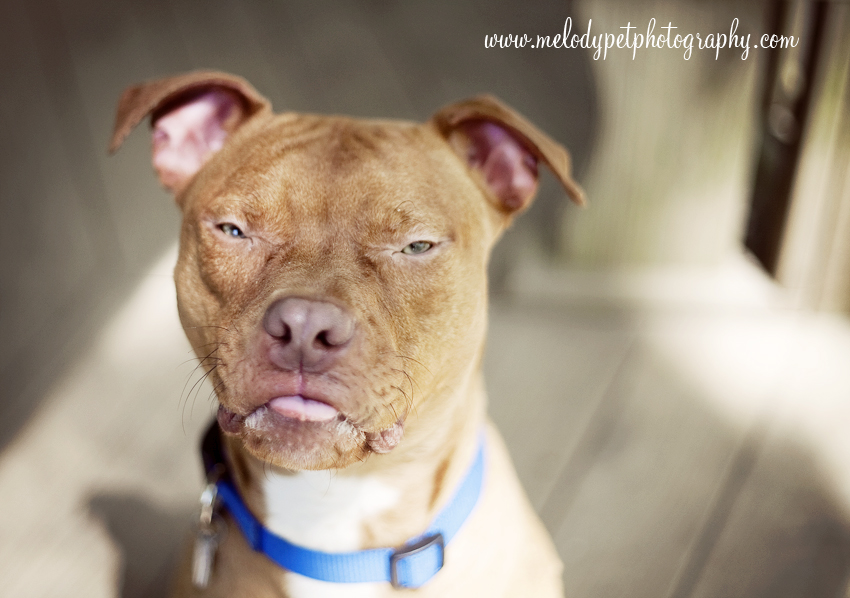
Thanks to everyone who played the caption game over on Facebook this week!

For those of you that missed it, we asked Team DINOS to submit their best captions for a chance to win Dog Flags.

Here’s the photo:

And the winners are…


Lisa Anderson

Lisa won with the most “likes” for her caption:

“Mom always told me if I kept making this face, it would freeze like this!!”


and


Amy Houselog Turner

Amy won because Boogie (aka Judge’s choice) loved her caption:

“DINOS: Dogs In Need Of Silliness!”


Lisa and Amy please email Kristin, the founder of Dog Flags, to claim your prize at: kristin@dog-flags.com (You’ll be able to pick the Dog Flag of your choice and they’ll ship it directly to you!)


Thanks for a fun contest everyone and a huge high five to

Dog Flags and Melody Pet Photography for making it all possible!